


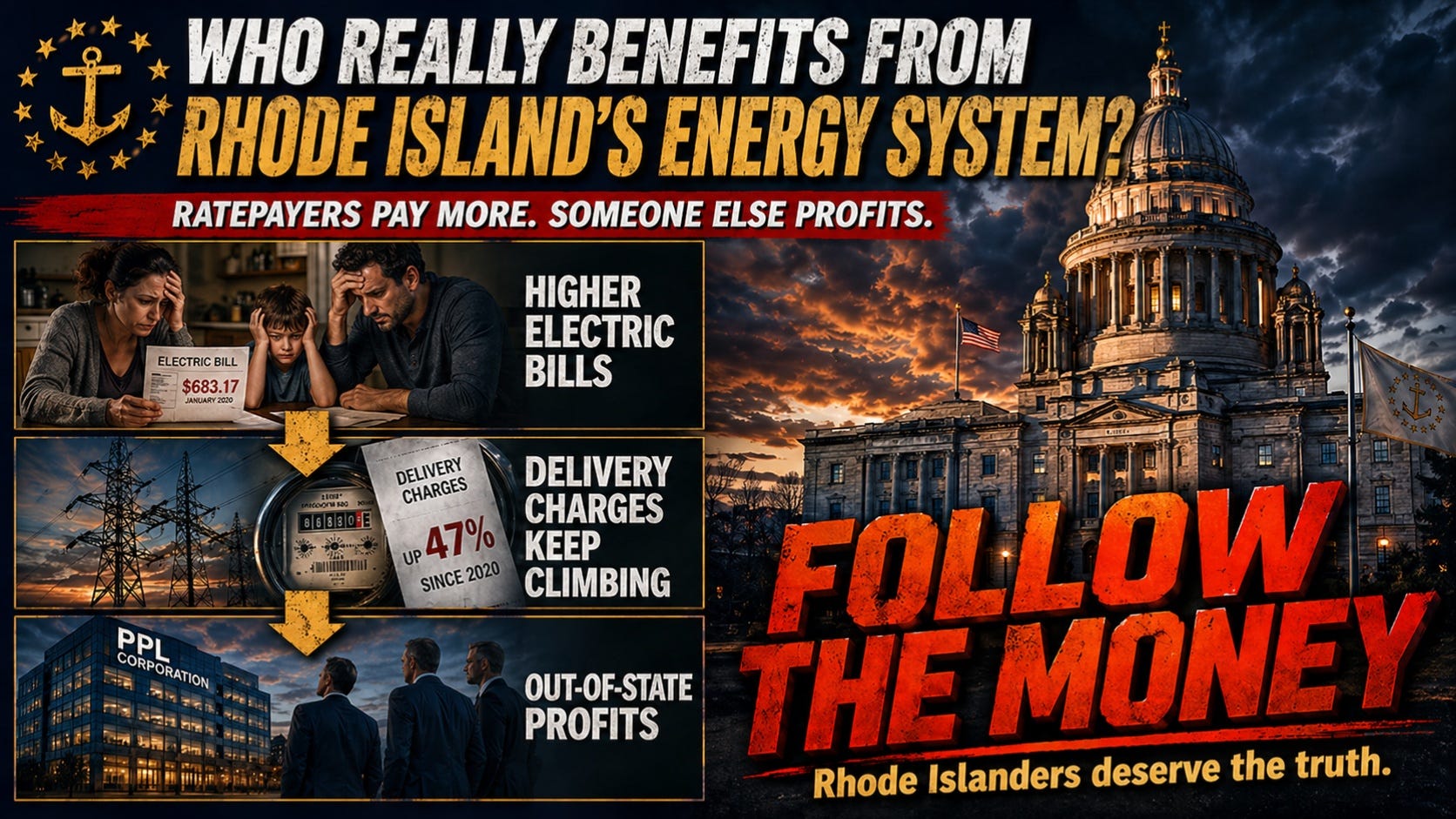
I spent the last week going through public records.
PUC rate case filings. PPL Corporation SEC disclosures. Rhode Island Ethics Commission lobbying data. Board of Elections campaign finance records. Power purchase agreements. RES compliance reports. Rate increase approvals going back a decade.
Here is what the record shows.
Open a Rhode Island Energy bill and look at the full breakdown. There is the supply charge for the electricity you actually used. And then there is the delivery charge. The fee Rhode Island Energy collects just to move that electricity from the grid to your home. In most Rhode Island households the delivery charge equals or exceeds the actual supply charge. You can use less electricity. You can turn off lights. You can buy efficient appliances. The delivery charge stays. It is fixed. It is mandatory. And it keeps climbing with every approved rate case.
Real world residential bills average 247 dollars a month for electricity alone when you add supply and delivery together. Add gas heating, water heating, and winter peak surcharges and total home energy routinely hits 500 to 650 dollars for thousands of households across this state. The energy you used is only half the bill. The other half is the cost of a delivery system owned by an out of state corporation with a guaranteed profit built into every dollar it charges you.
Governor McKee’s answer to all of that is fifteen dollars a month.
But the fifteen dollar number is not the real story. The real story is what the public record reveals about who Rhode Island’s energy system was actually built to serve. And the answer is not the families opening those bills every month.
Follow all four layers. The picture is clear and it is damning.
Layer One — The Utility and Its Parent Company
Start here because everything else flows from it.
Rhode Island Energy, formerly Narragansett Electric, is owned by PPL Corporation, a Pennsylvania based energy conglomerate. In 2024 PPL reported 1.25 billion dollars in profit from ongoing operations. The company pays its shareholders a consistent dividend of roughly 1.14 dollars per share annually.
This is not a coincidence. It is the regulatory compact.
Under this framework the Rhode Island Public Utilities Commission sets rates that allow Rhode Island Energy to recover every approved cost including capital spending, operations, and infrastructure, plus a guaranteed return on equity. The current base allowed return on equity is approximately 9.275 percent with incentives pushing it to 10.57 percent or higher and a ceiling near 11.74 percent.
In November 2025 Rhode Island Energy filed a docket seeking more than 180 million dollars in additional base distribution rate increases over two years. The first comprehensive rate review since 2017. While requesting a 10.75 percent return on equity.
This follows a consistent pattern. In 2022 alone a record 47 percent residential electric supply increase was approved by the PUC. Routine annual adjustments were layered on top. No matter what the Governor calls his plan the fundamental math does not change. PPL recovers its capital, its operations, and its profit through your monthly bill. Every dollar of the delivery charge. Every dollar of the supply adjustment. Every dollar of the rate increase. All of it flows through a regulatory system designed to make the utility whole before the ratepayer gets any consideration at all.
Accounting tweaks and mandate delays do not reduce those costs. They defer them to future ratepayers.
An out of state corporation reported 1.25 billion dollars in profit last year. Rhode Island families are choosing between heat and groceries. The regulatory compact made both outcomes possible simultaneously.
Layer Two — The Mandate Money
The second layer funds a different set of beneficiaries. And it shows up on your bill whether you know it or not.
Rhode Island’s Renewable Energy Standard requires utilities and suppliers to source escalating percentages of power from renewables. Every dollar of compliance cost gets passed directly to ratepayers through a dedicated line item on their bill.
In 2023 Rhode Island Energy alone spent 29.3 million dollars on RES compliance. Up from 16.2 million dollars in 2019. Adding roughly four to seven dollars per month to the average household bill. Statewide RES costs now exceed 90 million dollars annually and are projected to climb further as the mandate accelerates.
The beneficiaries of this mandated market are specific and traceable.
Revolution Wind’s Power Purchase Agreement locks in approximately 98 dollars and 43 cents per megawatt hour for twenty years. Offshore wind developers sell Renewable Energy Certificates into this market. Rhode Island Energy purchases those certificates to satisfy the RES. Every above market dollar gets socialized across the entire ratepayer base.
When wholesale natural gas is cheaper ratepayers still pay the contracted offshore wind price. That spread is a transfer. From working families to energy developers. Built into law by design. Every month. Mandatory.
A 2022 amendment pushed the RES target to 100 percent renewables by 2033. Governor McKee’s Affordability for All plan quietly walks that back to 2050. Not because it saves families money in the long run. Because it delays the pain long enough to survive an election cycle.
Layer Three — The Political Relationships and the Money Trail
This is where the public record gets uncomfortable.
Mandates do not write themselves. Rate structures do not approve themselves. And a system this profitable for this many people does not sustain itself without political maintenance.
Rhode Island has operated under one party control of the General Assembly for three decades. The public record shows that every major policy layer driving high energy costs was passed, expanded, or signed into law during that period of uninterrupted control.
The Renewable Energy Standard and its aggressive escalation schedule were championed by legislative leadership in both chambers. The Act on Climate passed in 2021, binding Rhode Island to net zero mandates and driving the RES acceleration, under full one party control. The 100 percent renewables by 2033 mandate was signed by the same Governor who is now quietly walking it back ahead of an election.
Meanwhile the General Assembly failed year after year to pass meaningful consumer protection reforms or utility accountability measures while ratepayer costs climbed and delinquencies mounted.
The lobbying record is public and searchable.
Rhode Island Energy and PPL Corporation spent approximately 139 thousand dollars on state lobbying in 2024 alone. Part of roughly 466 thousand dollars in documented Rhode Island lobbying expenditures between 2018 and 2024. Their registered lobbyists work the State House in Providence. Utility sector campaign contributions flow to General Assembly members who sit on the very committees that oversee energy legislation.
The environmental organizations that lobbied for RES expansions are part of the same ecosystem. Many receiving federal grants tied to the clean energy framework championed publicly by Rhode Island’s congressional delegation. The senators who champion renewable mandates on the Senate floor helped authorize the federal funding streams that sustain the organizations lobbying for those mandates at the state level.
What about the minority party. The public record shows they were largely powerless during this period. But their answer has rarely amounted to more than opposition without a comprehensive alternative. No serious Percentage of Income Payment Plan proposal. No meaningful supply diversification framework. No consumer protection legislation with real teeth. Criticism without a competing vision is not accountability. It is positioning.
The honest accounting is this. One party built the architecture. The other never offered a real alternative. And families paid for both.
This is not a conspiracy. It is a system operating exactly as designed. Just not designed for the people paying the bills. The documents are public. The lobbying filings are searchable. The campaign finance records are available. The rate case approvals are in the PUC dockets. None of this is hidden. It simply requires someone willing to look.
Layer Four — The Human Cost by Community
This is where the abstract becomes real.
Low income households in Rhode Island face energy burdens reaching 16 percent of household income. Approximately 27 percent of electric customers have fallen behind on their bills. Shutoffs and arrears climb year over year concentrated in older urban neighborhoods and low income communities where housing stock is inefficient and options are few.
Fixed income seniors in uninsulated triple deckers. Renters with electric heat and no ability to switch. Working families with 48 thousand dollar household incomes spending thousands annually on energy while delinquency notices stack up.
Neighboring states with similar renewable mandates achieve lower rates through greater supply diversity and different regulatory structures. Rhode Island’s near total dependence on natural gas, approximately 87 percent of in state generation, combined with layered mandates and transmission constraints produces exactly the volatility that hits the most vulnerable households hardest every single winter.
The fifteen dollars a month McKee is promising does not reach these families in any meaningful way. A working family with a 400 dollar monthly electric bill sees less than four percent relief. A senior on fixed income with a 290 dollar bill still faces an energy burden that crowds out food, medicine, and basic needs. The gap between what the system costs and what these households can sustain is not closing. It is widening.
And the people who designed the system that produced these outcomes just sent out a press release calling it Affordability for All.
What the General Assembly Needs to Do Right Now
The authority to change this exists. The bills are already filed. The dockets are open. Here is what real reform actually looks like.
Least cost procurement first. Require all source competitive bidding across gas, nuclear, hydro, efficiency, and renewables with rigorous cost benefit analysis before any mandate expansion. The cheapest resource that meets reliability standards wins. Not the most politically connected one.
Full transparency on every rate case. Require ten year rate impact modeling for every policy change filed with the PUC. Mandate full public disclosure of all utility lobbying expenditures and campaign contributions in conjunction with active rate cases. Rhode Island ratepayers should know exactly who is in the room when their bills are being set.
Percentage of Income Payment Plans. Cap energy burdens at six percent or less for vulnerable households. Flat dollar discounts do not scale to need. Income based plans do. They are proven in every state that has implemented them seriously. The General Assembly has had this bill in front of it. It needs to pass it.
True retail competition with real consumer protections. Expand community choice aggregation. Ban deceptive residential supplier contracts that have already cost Rhode Island ratepayers millions in above market charges. These are documented ongoing harms. They need to stop now.
Supply diversification. Fast track permitting for diverse generation including gas bridge capacity, nuclear, and hydro where zero emission and cost competitive. Invest in transmission upgrades that reduce dependence on volatile spot markets. Rhode Island’s 87 percent natural gas dependence is a structural vulnerability. Every Rhode Island family feels it when markets move.
The documents and filings referenced throughout this piece are public record. The PUC dockets are open. The PPL SEC filings are available. The Rhode Island Ethics Commission lobbying database is searchable. The Board of Elections campaign finance database exists. None of this requires a source inside the building. It requires someone willing to look, connect the dots, and say plainly what the numbers show.
The Bottom Line
Rhode Island’s energy system does not fail families by accident.
It succeeds extraordinarily well for everyone it was actually built to serve. An out of state utility corporation with a guaranteed return on equity. Offshore wind developers with twenty year contracts locked in above market rates. And the political infrastructure that keeps the whole arrangement intact through lobbying, campaign contributions, and mandate expansions that never seem to get reversed no matter which party is complaining about them.
One party has held the levers of power in this state for thirty years. The public record shows that party’s leadership championed every mandate that added to your bill. The same lobbying database shows utility sector money flowing to the committees that oversee energy legislation. And the same Governor who signed the 100 percent renewables by 2033 mandate is now offering fifteen dollars a month and calling it a revolution.
Rhode Islanders deserve an energy system that works for them. Not the reverse. The General Assembly has the tools. The question is whether its majority has the will to use them against the very system the public record shows they built.
Governor McKee may call it Affordability for All.
The public record calls it something else entirely.
And now you have the receipts.