

Imagine waking up Saturday morning, turning on the news, and seeing it again.
Another Rhode Island bridge. Another failure. Another close call that could have killed people.
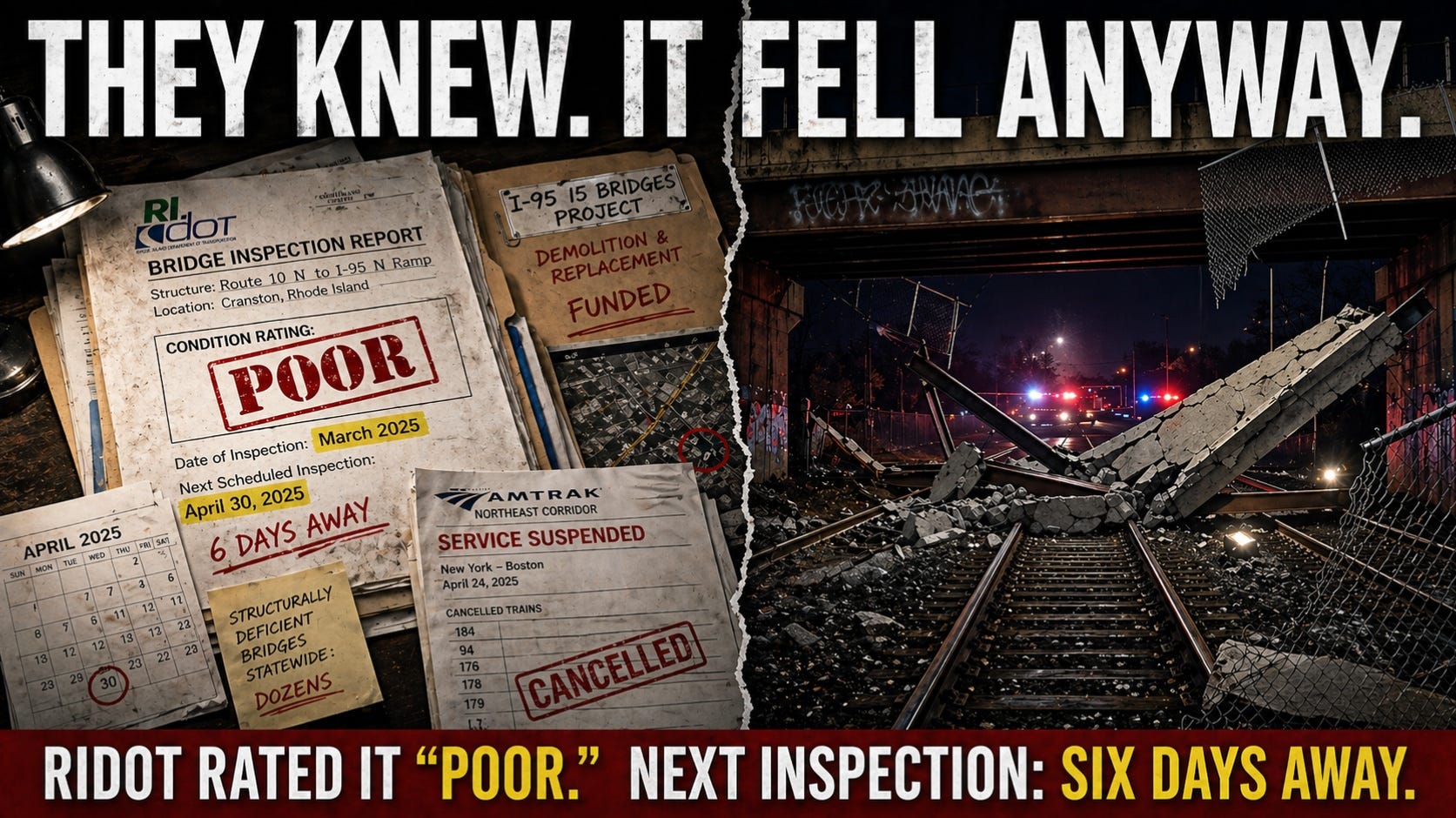
That is exactly what happened Friday night in Cranston. At 7:30 p.m. on April 24th a concrete parapet and steel debris fell from the Route 10 North to I-95 North on-ramp directly onto Amtrak’s Northeast Corridor tracks near Wellington Avenue. Chunks of concrete. Steel debris. One of the busiest rail lines in America running directly below.
No train was underneath it.
I want you to sit with that for a second. Because the only reason this is not the worst story Rhode Island has ever had to tell is timing. Pure timing. Nothing else.
What RIDOT Knew
This was not a surprise. Not to the people whose job it is to know.
RIDOT’s own inspection records rated this structure poor as of March 2025. The next scheduled inspection was April 30th. Six days away. The bridge was already flagged for demolition and replacement under the I-95 15 Bridges Project. Rhode Island taxpayers are funding that effort to the tune of hundreds of millions of dollars.
The agency knew this bridge was deteriorating. It was in the system. The project was funded and named. Cranston Police Chief Col. Michael Winquist, RIDOT Acting Chief Engineer John Preiss, and Amtrak officials all responded Friday night. Power was cut to the tracks. Crews worked through the night clearing debris and inspecting the corridor.
The structure fell before any of the scheduled work reached it.
I do not know how to make that sound acceptable. Because it is not.
What It Cost
Amtrak suspended all service between New York City and Boston. Trains 184, 94, 176, 178, 179, and multiple Acela runs were canceled outright. Trains already moving were terminated at the nearest station. Kingston Station filled up with stranded passengers who had no good options and no clear answers.
As of Saturday morning no restoration timeline had been announced. The on-ramp is closed. Wellington Avenue is shut in both directions. Commuters, families, and small businesses that depend on that corridor are absorbing the cost of a failure that should never have happened.
This is not an abstraction. Real people missed real things Friday night. And the disruption does not stop at the Rhode Island border. This is the Northeast Corridor. Every state on that line felt what happened in Cranston.
The Pattern
Senator Jessica de la Cruz asked the question that needed to be asked. “Is over $1B a year in taxpayer spending on RIDOT actually delivering results for Rhode Islanders?”
State Representative Michael Chippendale drew the line that has to be drawn. “The Washington Bridge near catastrophe was averted by dumb luck, by a kid who was doing a completely different job than inspecting the bridge. Now we have the entire protective side structure of a state overpass free falling onto the train tracks. Had there been a train coming just prior — there could have been hundreds of deaths.”
Two bridges. Two near-disasters. Both survived because of timing.
Not oversight. Not the inspection schedule. Not the project management. Timing.
Rhode Island has been getting lucky. And luck always runs out eventually. Friday night in Cranston it almost did.
What Has To Change
I am not here to score points off a collapsed bridge. I am here because Rhode Island families have absorbed the cost of decisions made by people who are never held accountable for the outcomes. That has to stop.
Here is what I am calling for.
An independent forensic audit. Bring in an outside engineering firm with no ties to RIDOT and no stake in the current project. Audit every bridge in the 15 Bridges corridor. Publish the full report online within 60 days. Condition ratings. Timelines. Cost overruns. Who signed off on structures rated poor that were still in active use. Taxpayers funded this project. They deserve to know exactly what they bought.
A bipartisan oversight commission with real authority. The General Assembly needs to create a standing commission with equal representation and genuine subpoena power. Not a committee that holds one hearing and disappears. A permanent body that reviews every major RIDOT project before the next dollar is committed. Real oversight means real independence. That starts with ending one-party rubber stamps on billion dollar infrastructure decisions.
Poor and fair rated structures go to the front of the line. RIDOT’s own data shows dozens of bridges statewide in poor condition right now. Stop announcing new projects until every structurally deficient bridge is fixed or replaced. Performance-based funding means money follows results. Not press releases. Not ribbon cuttings. Completed work that Rhode Islanders can drive over and trust.
A live public transparency dashboard. Every Rhode Islander should be able to open a webpage and see every bridge’s inspection date, condition rating, and repair status in real time. If a structure is rated poor it shows up in red. No more burying problems in agency paperwork until concrete hits the tracks. Sunlight is the best accountability tool we have.
Performance-based contracts. Invite private engineering firms to compete on fixed-price fixed-time contracts with real bonuses for finishing early and real penalties for delays and cost overruns. Competition produces results. The current system has produced this.
Tie RIDOT leadership compensation to outcomes. No automatic raises while bridges are failing. Director-level pay should be tied directly to reducing the number of poor-rated structures and delivering projects on time and on budget. If the bridges keep falling the bonuses stop. It is that simple.
Our congressional delegation needs to do their jobs. Rhode Island sends Senator Jack Reed, Senator Sheldon Whitehouse, Congressman Gabe Amo, and Congressman Seth Magaziner to Washington. Their job is to fight for Rhode Island. Federal infrastructure dollars exist. The bipartisan infrastructure law put billions on the table. The question Rhode Islanders deserve an answer to is simple. How much of that money is coming here. How fast is it moving. And why are we still looking at bridges rated poor while federal funding sits waiting to be claimed. Reed and Whitehouse have been in the Senate for decades. Amo and Magaziner are in the House right now. This is their moment to show Rhode Island what they are actually delivering in Washington. Not press releases. Not photo opportunities at ribbon cuttings. Federal dollars moving toward crumbling Rhode Island infrastructure with a public timeline and a public accounting. That is the job. It is time to do it.
The Bottom Line
Rhode Island spends over a billion dollars a year on transportation. This is not a funding problem. The money is there. What is missing is accountability for where it goes and what it actually produces.
Working families across this state pay their taxes and follow the rules. They get in their cars. They board their trains. They trust that the infrastructure underneath them was maintained by people who took that responsibility seriously.
Friday night that trust fell onto the tracks near Wellington Avenue.
Rhode Island can do better than this. Not with more money. With more accountability. Real oversight. Real consequences. Real results.
That is what this state deserves. And it is long past time someone delivered it.