


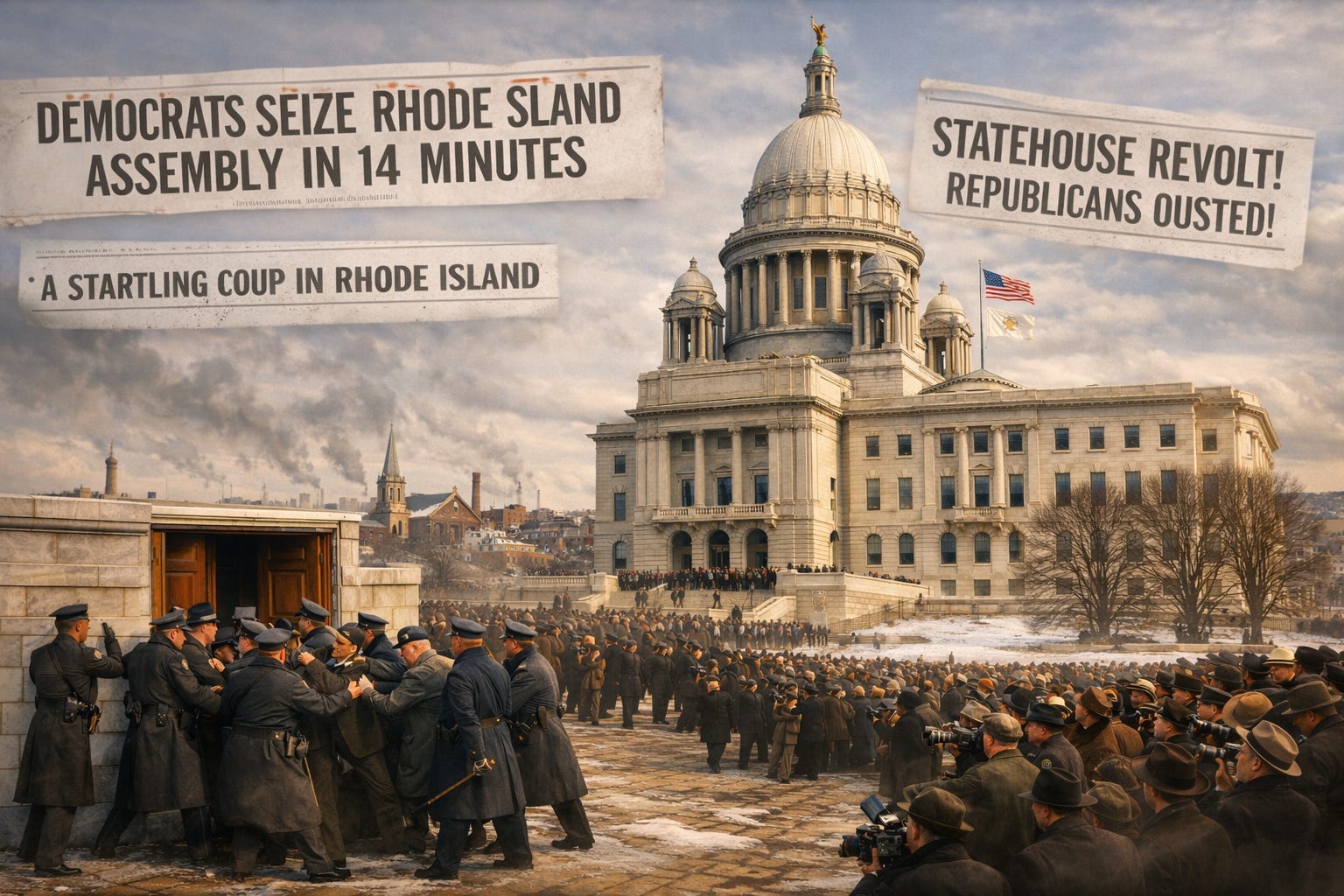
It was over before most Rhode Islanders finished their morning coffee.
On New Year’s Day 1935, in the span of fourteen minutes, the Democratic Party seized control of Rhode Island state government in one of the most audacious political power grabs in American history. No election. No mandate from voters. Just a lieutenant governor who refused to seat duly elected Republican senators, state police stationed at chamber doors so lawmakers couldn’t escape to break quorum, and a party that rewrote the rules of power while the rest of the state was still recovering from the night before.
The Associated Press called it the overthrow of a “Republican feudal system.” The New York Times labeled it “a startling coup.” The Christian Science Monitor declared that “50-year-old Republican domination is in shambles.” One conservative newspaper publisher was so outraged he ordered a star removed from the American flag in his pages, arguing Rhode Island no longer deserved its place in the union.
It was, by any honest measure, one of the most breathtaking moments in American state political history.
And Rhode Island has been paying for it ever since.
The Promise They Made and Broke
To understand why the Bloodless Revolution matters today, you have to understand what Democrats promised when they took power.
Rhode Island in 1935 was a state desperate for change. The Great Depression had gutted working families. Republican political boss General Charles Brayton had spent decades engineering a system that concentrated power in rural, Republican-leaning districts while urban working-class communities, the immigrant families, the factory workers, the mill hands, had little real voice in their own government. The Brayton Act effectively stripped the governor of appointment power, keeping control in the hands of legislative insiders and their networks.
Democrats rode into power promising to tear all of that down. Reform. Accountability. A government that finally answered to the people paying for it. A new era for Rhode Island.
Within months of taking power they had reorganized state government, consolidated dozens of commissions into a smaller number of departments, and restored real authority to the governor’s office. On paper it looked like genuine reform.
But future Rhode Island House Speaker Matthew Smith, writing in a 1973 edition of Rhode Island History, told the real story. The Democratic Party, he wrote, “failed to capitalize on its revolution and institute the program of reform it had promoted for so long.” Instead of following through on its promises, the newly empowered legislature “indulged in a wild scramble for patronage and power” that mirrored everything they had accused Republicans of doing.
“The real victims,” Smith concluded, “were the people of Rhode Island.”
That sentence was written in 1973. It reads like it was written this morning.
The Machine That Never Let Go
Here is the number that defines modern Rhode Island politics more than any other: 85.
That is how many consecutive years Democrats have controlled the Rhode Island House of Representatives, every single session since 1940. They have controlled the Senate without interruption since 1958. No other state in America has a legislative record quite like it.
When one party controls everything with no real fear of losing, something predictable happens. The party stops competing for your vote and starts assuming it. Accountability gets replaced by access. Reform gets replaced by relationships. And the people who suffer most are not the insiders with the right connections. They are the ordinary residents trying to build a life in a state that keeps making it harder.
The results in Rhode Island speak for themselves and they are not pretty.
Property taxes that rank among the highest in New England, climbing year after year with no meaningful relief in sight. A housing crisis that has been building for decades while the same legislators held panel discussions, commissioned studies, and passed incremental measures that never moved the needle. A business climate that consistently ranks near the bottom nationally, driving entrepreneurs and employers to neighboring states that are more affordable and more welcoming. A population that has been quietly shrinking as young families and working adults make the rational decision to leave.
And then there is the darkest chapter of all.
The Day 300,000 Rhode Islanders Lost Their Savings
In January 1991, newly elected Governor Bruce Sundlun walked into the State House on his first day in office and made a decision that stunned the entire state. He ordered the closure of 45 banks and credit unions, freezing the savings of approximately 300,000 Rhode Island depositors overnight.
The Rhode Island Share and Deposit Indemnity Corporation, the private insurance fund that covered most of the state’s credit unions, had collapsed. It had been underfunded, poorly supervised, and riddled with insider loans made to politically connected borrowers who never paid them back. The oversight failures that allowed it to happen were the direct product of a political culture where one party had run everything for so long that nobody with real power had any real incentive to ask hard questions.
Families lost access to their life savings. Businesses couldn’t meet payroll. The recovery took years. And the political culture that produced it changed far less than it should have.
I’ve lived here long enough to watch good people leave. Not because they wanted to. Because the math stopped working for them. The tax bill got too high. The rent got too steep. The opportunity they were waiting for never showed up. And they made the painful, rational decision to go somewhere that made more sense for their family. That’s not an accident. That’s not bad luck. That is the predictable result of ninety years of nobody in that State House being held genuinely accountable for anything. When you can’t lose, you don’t have to listen. And Rhode Island families have been living with that reality for nearly a century.
What Two-Party Government Actually Looks Like
Rhode Island’s closest neighbors offer a useful contrast.
New Hampshire operates with genuine two-party competition at every level of state government. Republicans and Democrats have traded control of the legislature and governor’s office multiple times in the past two decades. The result is a state that consistently ranks among the most affordable in New England, with lower property taxes, a stronger business climate, and a population that is growing rather than shrinking.
Massachusetts has its own structural Democratic advantages but has consistently elected Republican governors, from William Weld to Mitt Romney to Charlie Baker, precisely because voters understood that divided government produces better outcomes than unchecked single-party control. Baker won reelection in 2018 with 67 percent of the vote in a state that voted for Hillary Clinton by 27 points. Rhode Island voters are fully capable of making the same rational calculation.
Two-party government is not about ideology. It is about accountability. When both parties know they can lose, both parties have to actually govern. They have to deliver results. They have to answer to voters rather than to their own machines. That pressure produces better policy, better spending decisions, and better outcomes for ordinary people.
Rhode Island has not had that pressure in nearly a century. The evidence of what that costs is visible in every property tax bill, every housing shortage, every business that relocated to a more competitive state, and every young family that made the painful decision to leave a place they loved because they simply could not afford to stay.
November 2026 Is the Opportunity
The Bloodless Revolution of 1935 did not fix Rhode Island. It replaced one set of insiders with another and called it progress. The real victims, as Speaker Smith admitted fifty years ago, were the people of Rhode Island.
Ninety years of evidence has settled the question. One-party dominance does not produce good government. It produces comfortable insiders and frustrated residents. It produces a state with every natural advantage, a stunning coastline, world-class universities, proud communities, and genuine talent, that somehow keeps falling short of what it could and should be.
Rhode Island does not need to become a red state. It does not need to swing from one extreme to another. It needs two parties governing together, checking each other, competing honestly for every vote, and understanding that losing is always a real possibility. That accountability is the missing ingredient. It has been missing since January 1, 1935.
November 2026 is the moment Rhode Island voters have the opportunity to start rebuilding it. Not by picking a side. By demanding real competition at every level, in every district, for every seat.
Every uncontested race is a free pass for the machine to keep running. Rhode Island families have been handing out free passes for ninety years.
It is long past time to stop.