

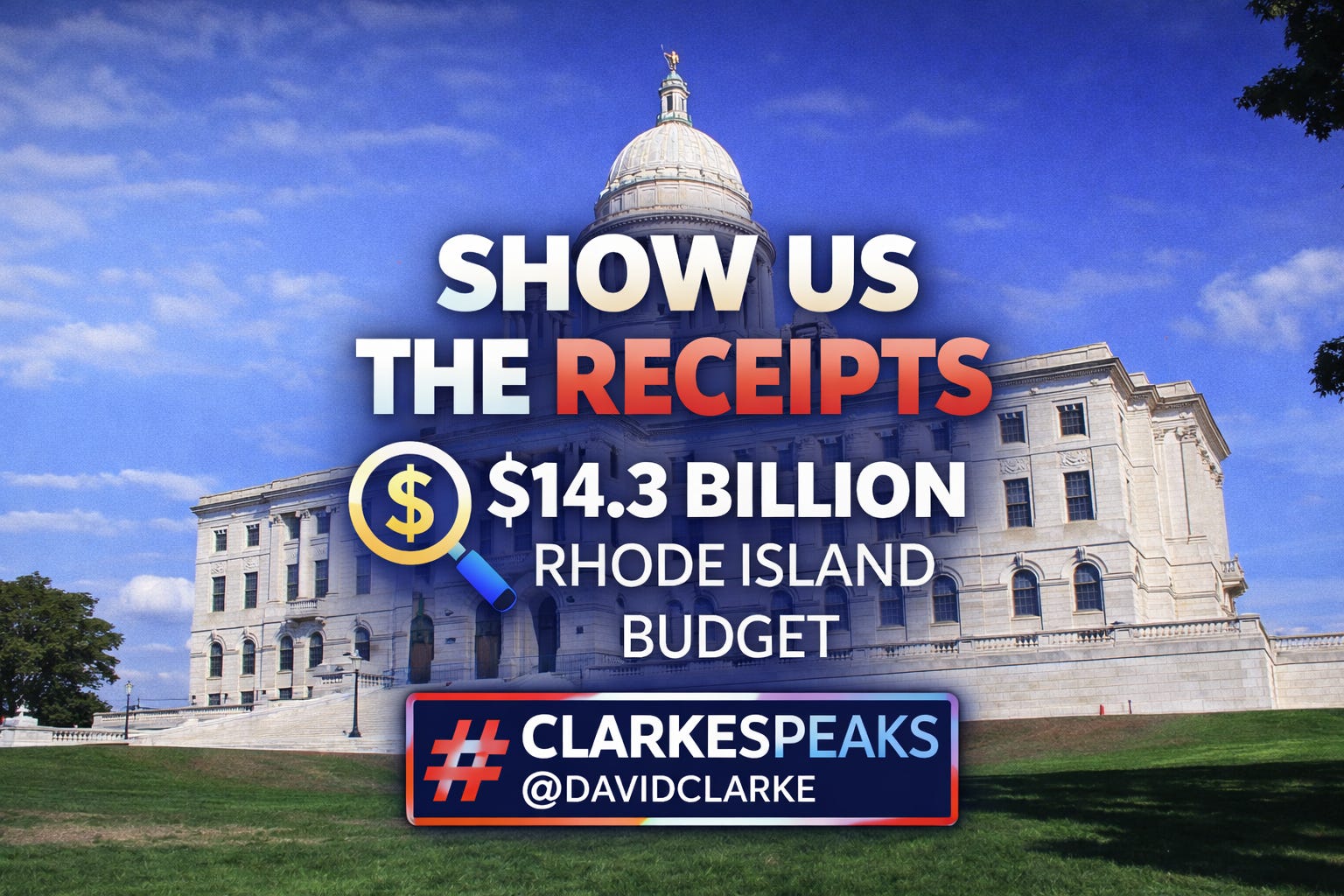
SHOW US THE RECEIPTS: RHODE ISLANDERS WANT A STATEWIDE AUDIT
Across Rhode Island, more and more people are asking the same question: with a state budget that keeps climbing past fourteen billion dollars, where is all of our money actually going? Rhode Islanders are watching their taxes, fees, and cost of living rise while still dealing with crumbling infrastructure, long waits for basic services, and mixed results in schools. That disconnect is driving a growing call on social media and in everyday conversations for a full, statewide “show us the receipts” audit of how our government spends every major dollar. This is not about left versus right. It is about basic fairness: if families and small businesses are expected to account for every bill they pay, the state should be willing to do the same.
People are not demanding an audit because they hate government or public workers. They are demanding it because they want government to work better. Rhode Islanders know there are essential services we all rely on – education, public safety, roads and bridges, health care for vulnerable neighbors. Those priorities have to be protected. The concern is that, layered on top of those core responsibilities, the budget has quietly grown thicker and more complicated every year. Programs created in one crisis stay on autopilot long after the crisis passes. Quasi‑public agencies handle big money with little public visibility. Contracts get renewed without serious scrutiny of performance. Ordinary residents trying to understand the budget run into hundreds of pages of jargon, acronyms, and line items that seem designed to keep them out.
That is why the demand you see online is for an independent, statewide audit, not just another internal review. Rhode Islanders are asking for a temporary, non‑partisan team of professionals – auditors, budget experts, and citizen representatives – with a clear mandate: follow the money, explain it in plain English, and recommend changes. The goal is not to “catch” one party or one personality; it is to map the system honestly. Which programs actually deliver measurable results? Which agencies are lean and effective, and which are weighed down by layers of administration and consultants? Where are there duplicate efforts that could be consolidated so we stop paying twice for the same thing? Those are questions that deserve real answers, no matter who currently holds office.
Fairness also means putting strong guardrails around how an audit would be used. Rhode Islanders asking for this are not calling for across‑the‑board cuts or attacks on front‑line workers. They are asking for information first, decisions second. A genuine statewide audit would:
Protect essential services while spotlighting waste, duplication, and programs that no longer match today’s needs.
Present findings in public reports and easy‑to‑read scorecards, so every resident – not just insiders – can see what’s working and what is not.
Require open hearings where agency leaders respond to the findings, explain what they are doing well, and how they plan to fix what is broken.
Handled this way, an audit becomes a tool for improvement, not a weapon. It gives honest public servants the data they need to make better choices, and it gives taxpayers confidence that tough decisions are based on facts, not rumors or back‑room deals.
Rhode Islanders also understand that transparency is a long‑term investment in trust. When government is seen as opaque or wasteful, people become cynical and tune out. That hurts everyone, because it becomes harder to pass good policies, harder to recruit talented people into public service, and harder to build support for necessary projects. A comprehensive audit, done fairly and publicly, sends the opposite message: “We have nothing to hide. Here is where every major dollar goes. Here is what we will change.” Even residents who disagree on ideology can respect that level of honesty.
Finally, the push you see all over social media is about giving voters a real say. Rhode Islanders do not want an audit to be a one‑time talking point that disappears after an election; they want it written into how the state does business. That could mean requiring a broad, independent review every few years, or putting a question on the ballot that explicitly authorizes a robust statewide audit and commits future leaders to act on the findings. Whatever the exact mechanism, the principle is the same: the people should not have to beg for transparency one budget at a time.
In a small state, every wasted dollar is a missed opportunity to fix a bridge, support a classroom, or ease the burden on a struggling family. That is why so many Rhode Islanders are now saying, in one voice, that the time has come for a serious, fair‑minded look at the books. Not to tear everything down, but to make sure what we are paying for actually works. Not to score cheap political points, but to build a government that is worthy of the people it serves.
The message is simple and powerful – and it is coming from all corners of the Ocean State: show us the receipts.