


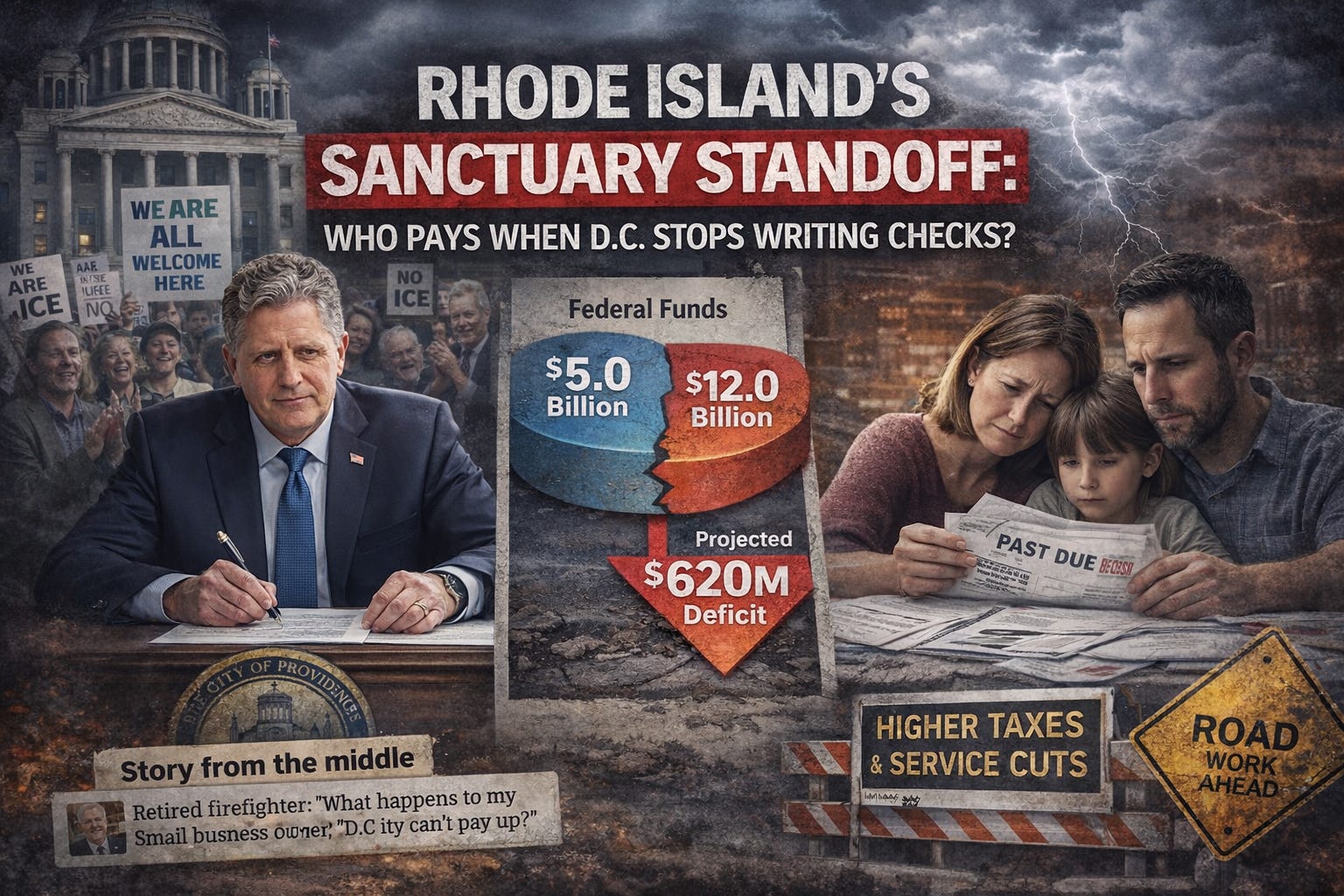
Rhode Island is walking into a political storm it is not financially prepared to weather.
On one side, local leaders are racing to plant a flag in the national fight over immigration enforcement. On the other, the state budget is quietly leaning harder and harder on money wired in from Washington. Those two realities are now on a collision course, and the people with the least say in the matter—taxpayers, small‑business owners, and city workers—are the ones who will eat the consequences if things go sideways.
A feel‑good order, a nervous city
Picture City Hall the day Mayor Brett Smiley signs his latest order telling federal immigration agents they are no longer welcome to use most city‑owned property for civil enforcement. Advocates cheer, cameras roll, and the press releases almost write themselves. Providence, we are told, is standing up for “safe and welcoming” values.
Drive a few miles in any direction, though, and the mood changes. Homeowners are staring at assessments that keep creeping up. Restaurant owners are trying to make payroll with food and utility costs still outpacing sales. Retired firefighters do the math on their pensions and wonder what happens if the city hits another fiscal wall.
For them, the key question is not whether City Hall feels morally satisfied. It is whether anyone has thought through what happens if Providence’s political statements trigger a fiscal reaction from a federal government that, for better or worse, now has an openly confrontational posture toward “sanctuary” jurisdictions.
How dependent are we on Washington?
Rhode Island is not a big, self‑financing empire. This is a small state with a narrow tax base and a long history of leaning on federal dollars to keep the books in balance. Medicaid, Medicare matching funds, housing vouchers, special education support, transportation grants, and assorted federal programs quietly fill in the gaps that state revenue cannot cover on its own.
Budget analysts have been warning for years that the state’s structural numbers are shaky even in good times. The pandemic temporarily disguised that reality with one‑time federal aid. Now that cash is fading out, the underlying math is reappearing: rising fixed costs, modest growth, and obligations—pensions, health care, infrastructure—that do not shrink just because the economy wobbles.
When your operating model depends on Washington wiring you a large share of what you need to keep hospitals open and classrooms staffed, you should think very carefully before daring the same federal government to test how far it can go in using funding as leverage. Legal limits exist, and courts have slapped down overreach in the past, but hoping judges bail you out is not a budget strategy.
Even a relatively small disruption—say, a delayed grant cycle, a freeze on a particular stream of law‑enforcement or housing money while a lawsuit drags on—would force ugly choices. Municipalities cannot print dollars. They raise property taxes, cut services, or both.
The sanctuary two‑step
Part of the tension in Rhode Island politics right now is that different levels of government are trying to have it both ways.
In Providence, City Hall is moving step by step toward a full‑blown sanctuary posture. Police are told not to ask about immigration status in routine interactions. Civil cooperation with federal immigration enforcement is dialed down. City property is declared off‑limits for ICE to stage civil operations. Activists get the symbolism they want, and Democratic elected officials get footage that plays well on national Twitter and cable hits.
Up the hill at the State House and across town at the governor’s office, the language is more cautious. Governor Dan McKee insists Rhode Island is “not a sanctuary state” and frames the policy line as simple constitutional compliance: follow warrants, cooperate on criminal matters, do not obstruct federal law. The message is meant to reassure moderate voters and Washington at the same time: we are not defying you; we are just setting our own priorities.
That split posture cannot hold forever. When the largest city in the state is explicitly codifying barriers to federal civil enforcement and encouraging private property owners to do the same, outside observers do not parse the fine print between “state” and “city.” They see Rhode Island as another blue jurisdiction daring the federal government to pick a fight.
If or when that fight comes, no one in D.C. will care that the governor chose his words more carefully than the mayor.
What happens if D.C. calls the bluff?
Supporters of Smiley’s order argue that non‑cooperation on civil immigration matters makes communities safer by encouraging victims and witnesses to speak freely to local police. Opponents warn that the policy blurs lines, invites confusion, and signals that Providence is willing to bend federal law for the sake of a slogan.
Both sides usually skip the part where someone asks: what exactly is the plan if the federal government leans on the financial pressure points it controls?
If a presidential administration issues guidance tying certain discretionary grants to a minimum level of cooperation with federal law enforcement, does Rhode Island comply? Does Providence carve out quiet exemptions behind the scenes? Or do state and local officials dig in, sue, and tell residents to trust that the courts will eventually sort things out while the money is held up?
None of those choices are cost‑free. Compliance risks a backlash from activist groups and parts of the Democratic base. Litigation costs money and time, and there is no guarantee that every funding stream will be fully protected in the interim. Quietly backtracking on the policy undercuts the claim that this is a principled stand rather than a press event.
What residents deserve is not another round of talking points about “welcoming values” or “tough on crime” posturing. They deserve a clear explanation of who will pay the bill if federal dollars are slowed, reduced, or reprogrammed because Rhode Island’s leaders decided to test the limits of federal patience.
Voices from the middle
The easiest way to see the stakes is to listen to people with something real on the line but no ideological career to build.
Ask a retiree who spent three decades in the Providence Fire Department whether she feels confident the city can absorb a sudden loss of federal money without touching pensions or core services. She has lived through budget freezes and hiring caps. She knows how thin the margin is.
Talk to the owner of a small manufacturing shop in the Blackstone Valley. He depends on passable roads, predictable property taxes, and state training programs to keep his workers up to speed. If federal transportation or workforce grants are delayed for a year while lawyers argue over sanctuary policy, he does not get a do‑over on the contracts he signed.
Then there is the legal immigrant family that followed every rule, waited years for paperwork, and now runs a corner store. They are sympathetic to neighbors who are undocumented and living in the shadows, but they also know their kids’ school depends on Title I and special‑ed money and that the local clinic survives on a mix of Medicaid and federal health grants. They want safety and fairness, but they also want a solvent city and state.
These are the people who cannot afford to treat federal dollars as an abstract political bargaining chip.
The conversation Rhode Island actually needs
Rhode Island is capable of walking and chewing gum at the same time. The state can debate immigration policy, civil liberties, and community trust without pretending that budgets write themselves. It can insist on humane treatment for everyone while also insisting that elected officials be honest about trade‑offs.
That starts with a few basic admissions from the people in charge:
Sanctuary‑style policies are not just symbolic; they carry real legal and fiscal exposure in a climate where the federal government is increasingly willing to use the purse as a weapon.
Rhode Island is far more vulnerable to that pressure than large states and cities that have deeper tax bases and stronger reserves.
Voters are adults. They can handle an honest explanation of what might be at risk and how leaders intend to protect essential services if the fight with Washington escalates.
Until that conversation happens, every new “statement” from Providence or the State House should be read with a simple question in mind: does this make it more likely that Rhode Island will be forced to choose between political theater and a balanced budget—and, if so, has anyone done the math on who pays when the curtain comes down?