

Most Rhode Islanders don’t realize they live in a one‑party state. On paper, barely a third of registered voters here wear a party label. The rest call themselves “unaffiliated” or “independent,” and every few years someone declares that this must be a purple state waiting to be awakened. Then Election Day comes, Democrats sweep almost everything, and the map looks deep blue all over again.
So what’s going on?
Independence on paper, habit at the polls
For a lot of Rhode Islanders, registering unaffiliated isn’t a grand ideological statement. It’s a way of saying: “I’m not a hard‑core partisan, I just vote for whoever seems like the lesser headache.”
They are frustrated with taxes, school performance, and the cost of living. They roll their eyes at State House insiders and don’t have much love for Providence’s political class. Many are culturally moderate or even conservative on crime, immigration, and public‑safety issues.
But when they step into the booth, they usually end up coloring in the oval next to the Democrat. Not because they’re thrilled, but because they’re scared of the alternative.
Three things independents actually care about
When you talk to unaffiliated voters, the same priorities come up over and over:
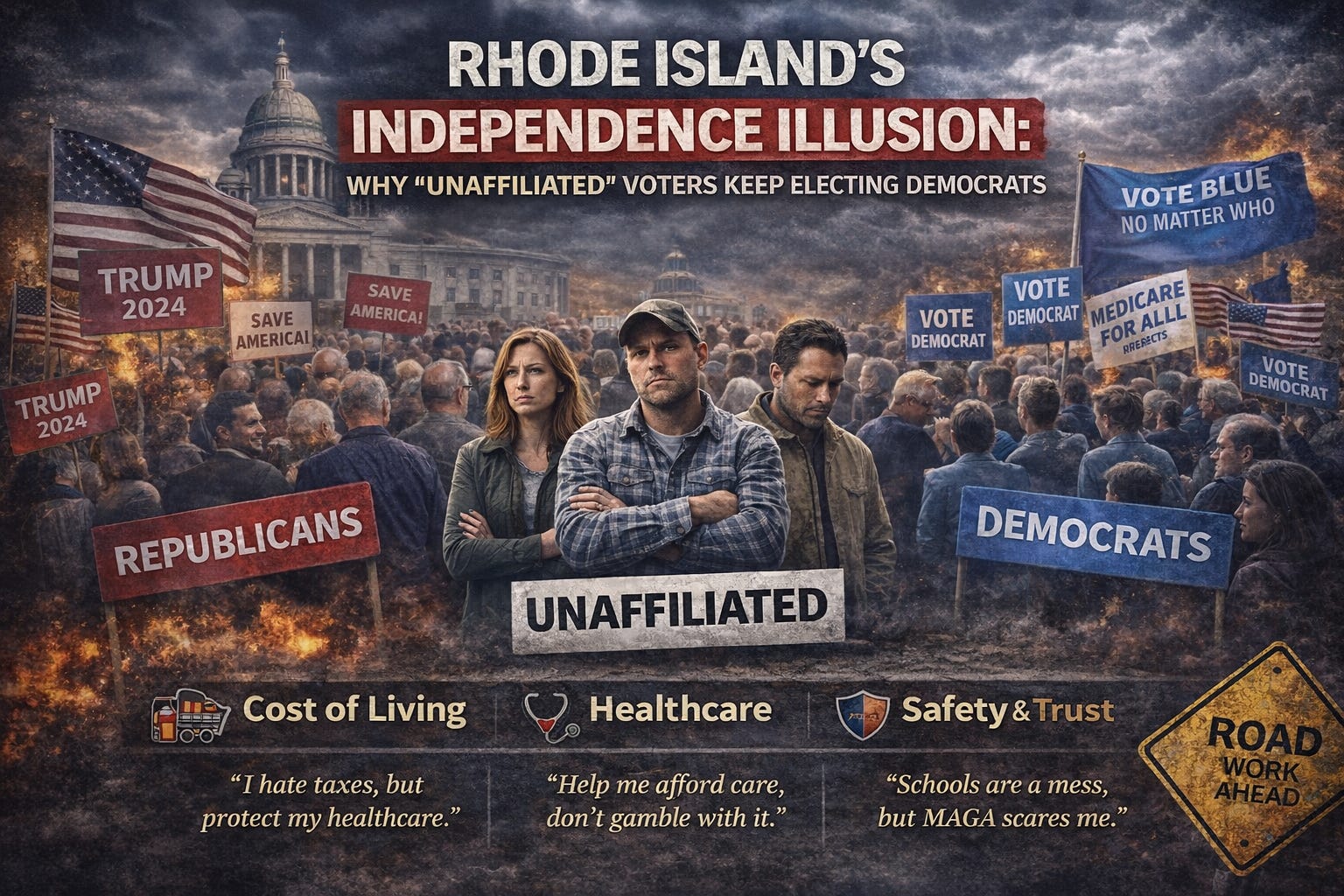
Cost of living. “Stop killing me with taxes and fees, and don’t wreck my job.”
Healthcare and retirement. “I can’t lose coverage or see my Medicare and Social Security turned into an experiment.”
Safety and trust. “I want schools that work, streets that feel safe, and leaders who aren’t clowns or extremists.”
Most independents would happily fire a bunch of entrenched Democrats if they believed the replacement would keep those three pillars steady. The problem is that, in Rhode Island, they usually don’t.
Why they default to Democrats anyway
There are a few reasons the default setting stays blue even when independents are grumbling.
The national GOP brand scares them.
Whatever their issues with local Democrats, many unaffiliated voters associate Republicans with Trump, January 6, election denial, and constant culture‑war drama. They might like a tax cut, but they don’t want to sign up for chaos or conspiracy theories.
Plenty of unaffiliated voters are furious about taxes and schools, but the idea of handing power to a MAGA, “stop the steal,” Jan. 6‑style politician—at the State House or in Congress—is a hard no. New England is where MAGA campaigns go to die, and most Rhode Island independents intend to keep it that way.
Faced with a choice between a Democrat they half‑trust and a Republican they actively fear, they pick the devil they know.The local GOP doesn’t feel serious.
In other states, center‑right parties win by looking competent, steady, and focused on bread‑and‑butter issues. In Rhode Island, too many Republican candidates show up late, raise little money, chase fringe fights, or run to build a personal brand instead of a coalition. Independents look at that and think: “I’m mad at the Democrats, but these guys don’t look ready to run a town council, never mind a state.”One‑party rule feeds on itself.
Because Democrats control almost everything, they attract ambitious young people, donors, and interest groups. If you want to get something done—on labor, healthcare, or local projects—you work through the dominant party. That makes it even harder for challengers to build a credible bench, which reinforces the feeling that voting Republican is a protest, not a governing choice.
How independents see both sides
When independents talk about Democrats, they don’t sound like party loyalists. You hear complaints about:
Taxes creeping up while services don’t improve.
A sense that insiders and connected nonprofits always get taken care of first.
State and city leaders spending more time chasing national headlines than fixing basics like schools, roads, and licensing.
But when they talk about Republicans, a different worry kicks in:
“I don’t want a MAGA person representing this state.”
“I can’t risk my healthcare or retirement on someone who thinks government is the enemy.”
“I’m mad about how things are going, but I don’t want to burn the house down.”
So even when both parties are underwhelming, Democrats benefit from being seen as flawed managers, while Republicans are seen as a potential risk.
The illusion – and the opportunity
That’s the independence illusion in Rhode Island: voters think they’re balancing the parties by staying unaffiliated, but the outcomes look almost identical election after election. One party governs, the other vents, and the middle keeps paying higher prices for the same problems.
The opportunity—for anyone serious about changing that—is not to lecture independents about their voting habits, or to demand they “get with the team.” It’s to actually earn their trust on the things they care about most:
Show how to lower the cost of living without threatening basic healthcare.
Offer real plans to fix schools, infrastructure, and public safety with timelines and trade‑offs, not slogans.
Prove you can reject extremes on both sides and still be tough on corruption and waste at home.
This isn’t a pitch for Democrats or Republicans; it’s a challenge to both sides to earn the votes of people who don’t owe them anything. Until candidates start meeting that standard, Rhode Island’s unaffiliated majority will keep doing what they’ve done for years: grumble about the status quo, hold their nose, and vote for Democrats—not because they love the results, but because they don’t yet see a safer option.