


Dear Members of the Rhode Island General Assembly,
Every spring, Rhode Islanders open their property tax bills and feel the same gut punch.
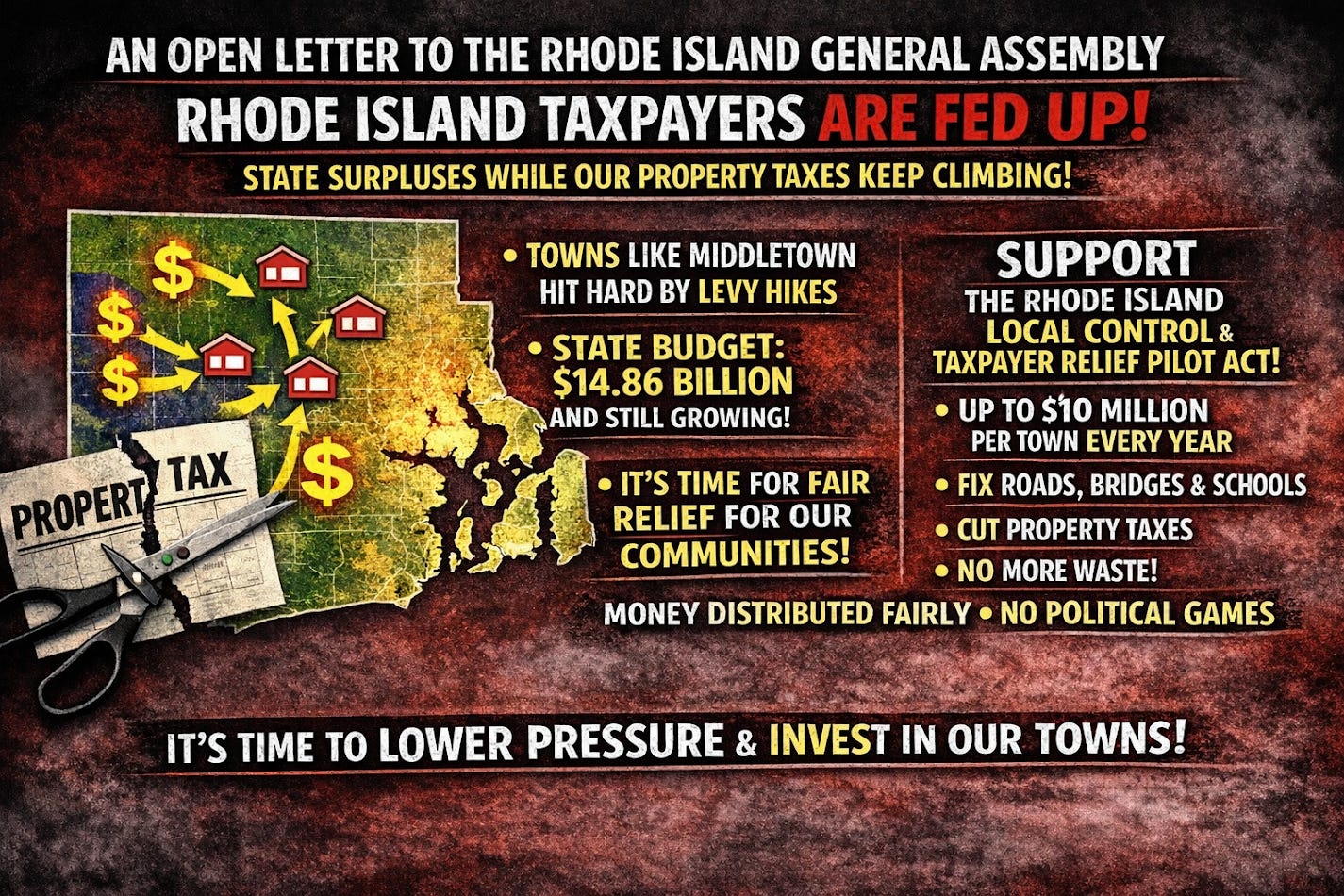
In towns like Middletown, the levy is set to rise another 3.7 percent this year, which means $2.17 million more pulled from homeowners, even after local officials held town spending to a 3 percent cap and the schools cut more than 20 positions. That tells me this is not simply a local spending problem. It is a revenue problem caused by a tax base that is not growing fast enough.
A lot of Rhode Islanders already believe state government spends far more than it should. They look at a $14.86 billion total state budget for FY2027, a double-digit figure that keeps climbing, and they ask a fair question: why do local property taxes keep going up every year while the state is sitting on surpluses and a fully funded $307 million rainy-day account?
Their frustration is real. And it is justified.
There is a better way.
I am proposing the Rhode Island Local Control & Taxpayer Relief Pilot Act, a true five-year pilot program that would provide Rhode Island’s 39 cities and towns with up to $10 million annually through a transparent formula based on population, local property-tax burden, infrastructure need, and school facility need, on top of the state aid they already receive.
The total cost would be up to $1.95 billion over five years, or up to $390 million annually. That works out to roughly 6.5 percent of a single year’s general-revenue budget. This is something the state can afford if it first orders a full independent performance audit to identify waste, then uses those savings along with the modest revenue actions already included in the Governor’s FY2027 plan and, if necessary, a limited temporary draw from our healthy rainy-day fund.
This pilot should come with real teeth so nobody can call it a blank check.
Every dollar should be limited to the following:
• Infrastructure, including roads, bridges, drainage, sidewalks, and broadband or fiber-optic projects
• School facility maintenance and safety upgrades
• Direct homestead or property-tax credits for resident taxpayers
• Debt service on previously approved capital projects
• Municipal energy aggregation, community choice aggregation, or bulk electricity procurement programs, including startup costs, rate subsidies, joint purchasing agreements with other municipalities, or regional energy-buying initiatives
No funds should be used for salaries, general operating expenses, or any other unrelated purpose.
Rhode Island taxpayers would overwhelmingly support an approach like this. People are tired of watching their bills go up while the state budget keeps climbing into the double-digit billions. They want to see real relief. They want to see frozen or lower tax bills, better roads, stronger schools, and improvements they can actually see in their own communities. And they want that relief delivered with full transparency.
This approach would also respect local control. Local elected officials, not distant bureaucrats, should be the ones deciding how best to use these funds within clear limits and public reporting requirements.
Our cities and towns would welcome this. Local leaders have been asking for stable, flexible aid for years. A pilot like this would give them a real chance to ease pressure on property taxpayers, address crumbling infrastructure, and pursue smart local improvements without putting even more strain on homeowners.
This is not about handing towns money and saying, “go to town.” It is about returning taxpayer money to local communities in a responsible, transparent way with strict guardrails and one goal: real relief for the people paying the bills.
This is not more big-government spending. It is smart, limited, accountable relief that brings money and decision-making closer to the people who actually pay for government in the first place. It is practical, targeted, and the kind of common-sense reform that Republicans, Democrats, and independents should all be able to get behind.
I respectfully urge the General Assembly to introduce the Rhode Island Local Control & Taxpayer Relief Pilot Act this session.
Rhode Islanders have waited long enough.
Respectfully,
A concerned Middletown, Rhode Island resident
Rhode Island Local Control & Taxpayer Relief Pilot Act
Working Policy Framework
Purpose
The Rhode Island Local Control & Taxpayer Relief Pilot Act would create a five-year statewide pilot program designed to return a portion of taxpayer dollars back to cities and towns in a responsible, transparent, and relief-focused way.
The goal is simple: ease pressure on local property taxpayers, help municipalities address long-neglected infrastructure and facility needs, and give communities more control over how targeted state support is used, without creating a blank check for general spending.
Why This Is Needed
Across Rhode Island, homeowners and local taxpayers continue to face rising property-tax pressure even as the overall state budget keeps growing. In many communities, local officials are already trying to control spending, but the tax base is not growing fast enough to keep up with infrastructure needs, school facility costs, debt obligations, and other major local pressures.
This proposal starts from a basic principle: Rhode Islanders should be able to see a clearer return on the tax dollars they already send to government.
Pilot Structure
This proposal would establish a five-year pilot program running from FY2027 through FY2031.
Under the pilot, Rhode Island’s 39 cities and towns would be eligible to receive up to $10 million annually through a transparent funding formula.
The program would be designed as a temporary, measurable test model, not a permanent entitlement. At the end of the pilot period, the General Assembly would review the results before deciding whether any part of the program should continue.
Funding Approach
The pilot would be supported through a combination of:
• savings identified through a full independent performance audit of state government
• selected revenue measures already proposed in the Governor’s FY2027 budget
• if necessary, a limited and temporary draw from the state’s Budget Reserve and Cash Stabilization Fund
The idea is not to grow government for the sake of growing government. The idea is to redirect resources more effectively and return measurable value to taxpayers at the local level.
Distribution Formula
Municipal funding would be awarded through a transparent public formula based on practical local conditions, including:
• population
• local property-tax burden
• infrastructure need
• school facility need
The formula should be published in full and applied uniformly statewide. Funds should not be distributed through discretionary political decisions, informal negotiations, or special carveouts.
Each city and town should receive a guaranteed minimum level of support, while communities facing greater tax pressure, infrastructure strain, or school facility needs should be eligible for additional funding up to the program cap.
Protection Against Diversion
Funds appropriated for this pilot should be placed in a dedicated municipal relief account and distributed only according to the published formula established under the program.
No portion of the funds should be withheld, redirected, repurposed, reduced, or delayed for political reasons or backroom budget maneuvering. The purpose of the pilot is to provide predictable, transparent local relief, not create another avenue for favoritism, state-level skimming, or insider dealmaking.
Eligible Uses
Funds would be limited to clearly defined purposes that provide visible public value and real taxpayer relief.
Eligible uses would include:
• roads, bridges, drainage, sidewalks, and other core infrastructure projects
• broadband and fiber-optic expansion
• school facility maintenance and safety upgrades
• direct homestead or property-tax credits for resident taxpayers
• debt service on previously approved capital projects
• municipal energy aggregation, community choice aggregation, and bulk electricity procurement efforts, including startup and partnership costs
Ineligible Uses
To protect taxpayers and maintain trust, pilot funds would not be allowed to be used for:
• salaries
• general operating expenses
• pension costs
• routine administrative spending
• unrestricted local budget balancing
This is a relief and infrastructure tool, not a slush fund.
Local Control With Guardrails
A central principle of the pilot is local control. Cities and towns should have flexibility to decide which approved uses matter most in their communities.
At the same time, that flexibility should exist within strict guardrails, clear public reporting, and measurable performance standards.
This is meant to strike the right balance between local decision-making and taxpayer accountability.
Transparency and Reporting
Any municipality receiving pilot funds would be required to file a public annual report detailing:
• how funds were spent
• what projects or tax-relief measures were supported
• measurable outcomes
• the impact on the local property-tax levy, where applicable
These reports should be publicly accessible and easy for taxpayers to review.
Evaluation and Sunset
The pilot should include a formal review after year three and again at the end of year five.
Those reviews should examine:
• whether property-tax pressure was reduced
• whether infrastructure and school facility conditions improved
• whether towns used the funds effectively
• whether the distribution formula worked fairly
• whether the model should be refined, extended, or allowed to expire
The program should automatically sunset at the end of the five-year period unless reauthorized based on results.