

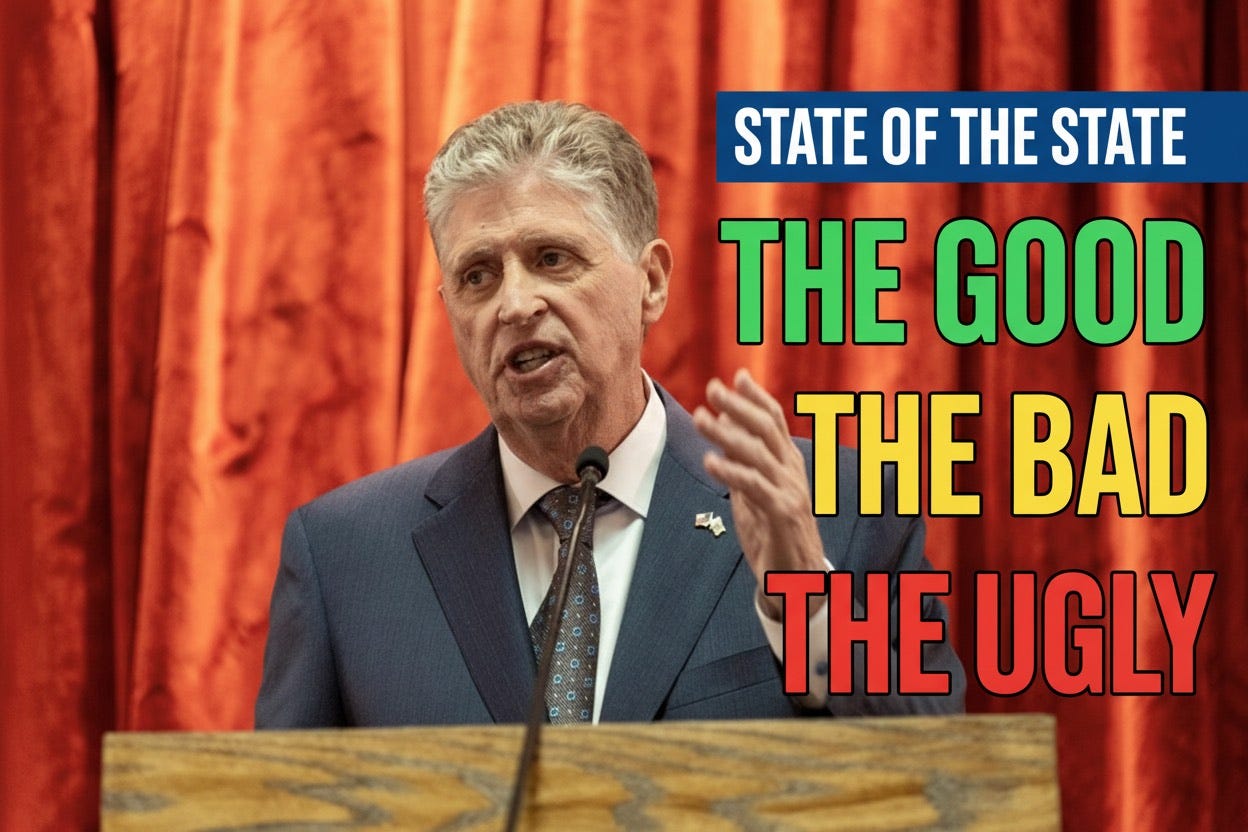
Rhode Island just heard a feel‑good State of the State. Now comes the hard part: math and accountability. Governor Dan McKee laid out an “Affordability for All” agenda packed with tax cuts, new programs, and nearly a billion dollars in new borrowing, all while the state stares at a budget deficit north of $100 million. The good news is some of what he promised is doable and would help real people. The bad news is a lot of it either pushes the bill onto future taxpayers or assumes the economy and Washington will cooperate. The ugly truth is simple: whenever you hear “$1.4 billion back in your pockets,” you should ask whose pockets it is coming out of—and how a State House run by the same party for 90 years suddenly discovered fiscal discipline.
The good: real help for real people
Some pieces of McKee’s speech will sound great to any working‑ or middle‑class Rhode Islander, regardless of party.
• Ending the state tax on Social Security would put more money in seniors’ hands and make Rhode Island more competitive with neighbors that already don’t tax benefits.
• Creating a permanent child tax credit, rolling back last year’s gas‑tax hike, and trimming the state add‑ons on electric bills would deliver direct, easy‑to‑understand relief to families that feel squeezed every time they go to the grocery store, fill up the tank, or open the power bill.
• Making the Hope Scholarship permanent so more students can finish college with less debt, and investing in career and technical education classrooms, are the kind of long‑term education moves that actually grow incomes instead of just redistributing today’s dollars.
• Putting more money into hospitals, Medicaid redeterminations, community health, and opioid‑treatment infrastructure addresses real problems instead of pretending the health‑care system will fix itself.
• Proposing new investments in housing, including a housing bond and a separate homeownership program focused on lower‑cost homes, at least acknowledges the reality that supply is lagging and prices are crushing young families.
Taken in isolation, almost every one of these items is defensible on the merits. Seniors should keep more of what they earned. Parents raising kids need a break. Housing supply is too tight. Hospitals and mental‑health providers are under real strain. These are the parts of the speech that fall under “good.”
The bad: promises vs. the deficit


Where the agenda runs into trouble is not in the goals, but in the math and the timing. Rhode Island is already facing a projected deficit of over $100 million in the coming budget cycle, with more gaps likely in the out‑years as federal pandemic‑era money disappears and costs like Medicaid grow faster than revenue. In that context, promising to keep $215 million “in people’s pockets” in the first year and $1.4 billion over five years is not a small tweak; it is a huge bet that growth, federal money, or new taxes on someone else will bail the state out.
Several of McKee’s marquee promises depend on one legislature after another signing off on them, year after year. Eliminating the Social Security tax is permanent unless a future Assembly reverses it. A permanent child credit becomes another line item that grows as population and eligibility grow. Reducing the state portion of electric bills sounds painless, but those charges often fund other programs and mandates; cutting them either means cutting the underlying programs or shifting those costs into the general budget.
On top of the recurring commitments, McKee wants voters to approve roughly $600 million in new bond debt for economic development, higher education, K‑12, housing, and a State History Center. Bonds are just borrowed money with interest attached. They can fund useful projects, but they are not free. Debt service then crowds out other spending down the road. When you stack permanent tax cuts on top of higher long‑term debt service, the question is not whether the numbers get tight; it is how quickly.
There is also a basic capacity problem. Housing 2030 aims for 15,000 new units by 2030—almost double the rate Rhode Island has managed in recent years. That requires not just money, but permitting reforms, local cooperation, and an industry that actually has enough workers and materials to build at that pace. The same goes for finishing the Washington Bridge “as quickly as possible”: engineering, contractors, lawsuits, and supply chains do not move at the speed of applause lines.
The ugly: who pays and one‑party rule

The ugliest part of this agenda is what McKee barely mentions: who ultimately pays and who has actually been running the state. For nearly a century, Democrats have controlled the Rhode Island State House. They have written the budgets, set the tax code, and overseen the agencies that now supposedly need “historic” fixes. If one party has run the show for 90 years, that party owns the results.
Yet McKee spends a big chunk of the speech blaming President Trump and “Washington Republicans” for Rhode Island’s problems—tariffs, energy prices, SNAP, Medicaid cuts. That plays well in a deep‑blue state, but it conveniently ignores who has held the pen in Providence. Republicans barely have a voice in the General Assembly; they did not create the chronic under‑building of housing, the pension and debt overhang, or the decision to paper things over with temporary federal money instead of structural reform. Blaming Trump and congressional Republicans for state‑level failures is not just spin; it is cowardly. It allows Democratic leaders to dodge responsibility for what decades of one‑party rule have done to the state’s finances and competitiveness.

There is also growing talk at the State House about a new “millionaires tax,” with supporters pointing to Massachusetts and insisting that higher earners did not flee after their surtax. That is a convenient story, but it underestimates how mobile high‑income residents and some businesses can be when tax and regulatory burdens stack up. Rhode Island already fights a reputation as high‑tax and business‑unfriendly. Piling on a millionaire’s tax while simultaneously adding new mandates and debt risks pushing out the very people and companies the Governor brags about attracting.
When you promise big permanent tax cuts and big new programs while already in a nine‑figure deficit, the money has to come from somewhere. There are only a few levers:
• Higher taxes on someone else. A millionaire’s tax is the obvious next step, no matter how carefully it is poll‑tested.
• Cuts to other services. You cannot protect every line of the budget at once. If Social Security taxes go away and child credits grow while revenue is flat, the state will eventually have to squeeze something—local aid, higher‑ed operating funds, or back‑office functions that people only notice when they stop working.
• More borrowing. Bonds feel painless in the short run because the bill arrives later. But a state that keeps layering on new debt while growth is modest and population is stagnant or shrinking is setting up a structural problem.
McKee’s speech also leans hard into “holding insurers accountable” and promising over $1 billion in long‑term “energy relief.” Those are crowd‑pleasers, but if caps and penalties on insurers are not paired with serious cost‑control and delivery‑system reform, they just push costs around the system—into narrower networks, slower approvals, or higher premiums in other markets. And cutting state surcharges on electric bills while fighting over offshore wind and other supply‑side issues is a balancing act that may not add up to the billion‑dollar savings he claims.
What he can probably deliver
There are pieces of this speech that, with a cooperative Democratic legislature, are likely to happen:
• A version of the Social Security tax repeal.
• Some level of permanent child credit, even if the dollar amount moves.
• A gas‑tax rollback, which is relatively cheap in the grand scheme and politically popular.
• A housing bond and a homeownership program, because bonding for housing has already been part of the state’s playbook.
• The CTE bond and parts of the higher‑ed bond package, especially if the projects are spread across multiple communities and campuses.
• Additional funding for hospitals, Medicaid redeterminations, senior centers, the Food Bank, and Planned Parenthood, since those align with the priorities of the current majority.
These items match both McKee’s goals and the ideological leanings of the General Assembly. The question is how much they are scaled down in committee to fit the budget reality.
What is least likely or most fragile
Other promises are far more fragile:
• Delivering the full claimed $215 million in first‑year relief and $1.4 billion over five years assumes no recession, no major federal cuts beyond what he has already identified, and no big cost overruns on projects like the Washington Bridge. That is optimistic bordering on unrealistic.
• Staying on track to finish the Washington Bridge two years before Maryland’s Key Bridge is not entirely under the Governor’s control. Weather, legal challenges, contractor issues, and federal oversight can all shift timelines.
• The long‑term housing target of 15,000 new units by 2030 depends on local zoning boards, neighborhood resistance, interest rates, and the capacity of builders, not just on a line in a speech.
• Holding private health insurers to strict caps while simultaneously asking them to absorb more risk in a changing Medicaid and marketplace environment is politically tempting but economically tricky. If not paired with serious cost‑control measures, it risks backfiring.
These are the areas where the promises sound big, but the execution risk is even bigger.
The bottom line for taxpayers
If every promise in McKee’s State of the State somehow became law tomorrow, Rhode Island families would see more money in their pockets in the short run. Seniors would keep more of their benefits, parents would get checks, and some bills would go down. But taxpayers—present and future—would also be on the hook for:
• Lost revenue from repealed or reduced taxes.
• Debt service on hundreds of millions in new bonds.
• Ongoing program commitments that are much harder to unwind than they are to announce.
Rhode Island’s future is worth fighting for. The real question is whether this wish‑list budget fights for that future honestly—or whether a State House run by one party for generations is once again pushing today’s political problems onto tomorrow’s taxpayers, and blaming someone in Washington when the bill finally comes due.