


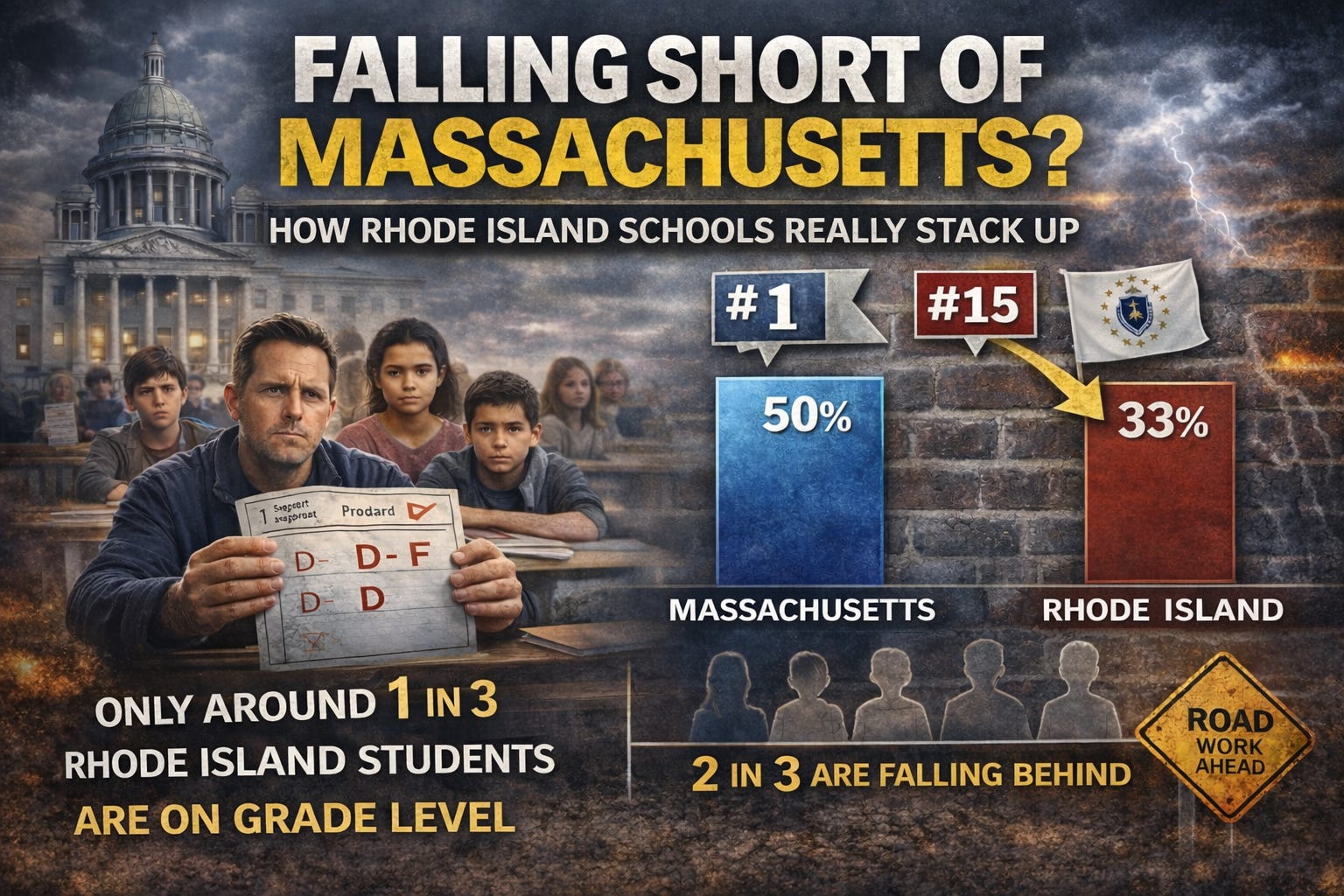
Rhode Island has climbed out of the basement on education, but we are still nowhere near where a small New England state should be—and we are definitely not in Massachusetts’ league yet. Only about one in three students is on grade level in reading and math, and families feel that gap every time they look at report cards, test scores, or try to get help for a struggling child. This is a story about where Rhode Island really stands, what’s working, what’s broken, and what it would actually take to give our kids a Massachusetts‑level education.
Lagging behind the class
For all the talk about “turning the corner,” the basic numbers are still ugly. Only around 33 percent of Rhode Island students meet grade‑level expectations in core subjects like reading and math, which means roughly two‑thirds are either below standard or far behind. When national rankings stack states up, Rhode Island sits in the low 30s—middle of the pack—while Massachusetts consistently fights for the number‑one or near‑top spot. If Rhode Island were a single classroom of 30 kids, only about 10 would be on track; the other 20 would be struggling to catch up in a system that was supposed to prepare them for the same future as their peers across the border.
The gap with Massachusetts is especially revealing because both states use essentially the same test. Rhode Island has closed about half of the achievement gap since 2018, which is real progress, but the distance is still big: on average, Massachusetts students are several points more likely to be proficient in both English language arts and math. In urban districts like Providence, Pawtucket, Woonsocket and Central Falls, the gulf between what kids are learning here and what kids are learning in Boston or Worcester can feel like a different country, not just a different state.
What Massachusetts gets right
Massachusetts is not perfect—its low‑income and minority students still face serious gaps—but it proves that better is possible. The state built its lead on three pillars: high standards, serious instruction, and a culture that expects success.
First, Massachusetts set a high bar in the 1990s and mostly stuck with it. The state exams are treated as real measures of learning, not suggestions or political bargaining chips. Graduation expectations are tied to those standards, so “passing” actually means something to colleges and employers. Second, the state invests heavily in early literacy and math. Evidence‑based reading programs in the early grades, coherent curriculum, and extra time for math give students a solid foundation instead of leaving them to catch up in middle school. Third, there is a culture—among parents, educators and business leaders—that academic rigor matters. A large share of Massachusetts high schools are nationally competitive, which pulls the rest of the system upward and sends a clear message: kids are expected to be able to compete anywhere in the country when they graduate.
Even Massachusetts has seen some slippage after the pandemic, especially for the students who need help the most. But that makes the Rhode Island comparison even more urgent. If the top state is wobbling and we’re still far behind, the choice is simple: either we move aggressively now, or we accept that our kids will keep starting the race ten yards behind their neighbors.
Rhode Island’s bright spots
To be fair, this is not the same Rhode Island school system from a decade ago. The state’s learning recovery from COVID was faster than many places; in some grades and subjects, scores have bounced back to or slightly above pre‑pandemic levels. The gap with Massachusetts in reading and math has shrunk compared to 2018, meaning we are at least moving in the right direction instead of drifting farther behind. That matters.
There are also islands of excellence that prove what’s possible. Some district schools, magnets and charter schools—especially in Providence, Central Falls, and certain suburbs—manage to put a much higher share of low‑income students on grade level than the schools down the street. They tend to have things in common: strong principals, consistent discipline, a clear curriculum, extra time for reading and math, and teachers who are supported instead of abandoned. The state has launched literacy initiatives, math coaching, and clearer public data dashboards that make it easier to see which schools are improving and which ones are standing still. None of this is enough, but it gives Rhode Island something real to build on instead of just slogans.
The problems no one wants to own
Progress does not erase the core problem: low expectations baked into the system. When leaders hold press conferences to celebrate small gains while two‑thirds of students are still below grade level, it sends a quiet message that mediocrity is acceptable. Too many schools have shifted the goal from “are students learning?” to “are we avoiding embarrassment?” In that climate, simply having kids physically in the building can be treated as a win, even if what happens between the bells is not moving them forward.
Chronic absenteeism and behavior issues drag the whole system down. Rhode Island saw absenteeism spike after COVID, and while there has been some improvement, far too many students still miss weeks of school every year. Kids who are anxious, dealing with unstable housing, or taking care of siblings cannot learn if they are not in class; kids who do show up are forced to learn in classrooms where disruptions are constant and teachers are burned out. Behind the numbers are mental‑health crises, transportation problems, and discipline policies that swing between zero‑tolerance and no‑consequences, with very little real support in the middle.
Quality is wildly uneven from school to school. A small group of high‑performing schools offers something close to a Massachusetts‑level education. Many others deliver quietly mediocre results year after year. The state’s accountability system produces reports and ratings, but actual consequences are rare. Schools can spend a decade in the “needs improvement” category, write new plans with new acronyms, and keep doing basically the same thing. Adults’ comfort takes priority over children’s outcomes. Meanwhile, students with disabilities, multilingual learners, and kids from low‑income families bear the brunt of this failure. Evaluations and services arrive late, “inclusion” often means being parked in the back of a crowded classroom without support, and the students who need the most get the least.
Charter schools and honest choice
Charter schools are one of the most polarized topics in Rhode Island, but they should be part of this conversation—honestly. There are charters in the state, often modeled on successful Massachusetts schools, that deliver significantly higher achievement for low‑income students than neighboring district schools. They usually share certain features: longer school days, a strong culture around behavior and effort, clear academic expectations, and relentless focus on reading and math. For the families whose children attend these schools, the test scores are not abstract; they translate into kids who can actually read on grade level and have a real shot at college.
But a charter is not automatically good just because it’s a charter. Some charter schools do no better—and sometimes worse—than the district schools serving similar students. Those schools should not be protected just because they are part of someone’s reform brand. The real question should not be “charters vs. districts,” it should be “does this school, whatever its label, get better results for the kids it serves?” If the answer is yes, it should be easier for that school to grow. If the answer is no, it should be fixed or closed. Families deserve options that work, not more ideological wars fought over their heads.
A plan to catch Massachusetts
If Rhode Island actually wants to compete with Massachusetts, not just admire it from across the border, then the state has to stop tinkering around the edges and start making big, sustained changes. That starts with raising standards and telling parents the truth. The state should keep rigorous tests and refuse to quietly lower cut scores just to make graphs look prettier. Every school should have a plain‑language report card that shows exactly what share of students are on grade level in reading and math, broken down by income, race, disability, and language status. Parents should be able to see, in seconds, whether their child’s school is preparing kids to stand toe‑to‑toe with Massachusetts.
Second, Rhode Island needs to go all‑in on early literacy and math. Every K‑3 classroom should use evidence‑based reading instruction, not whatever program a vendor happens to be selling this year, and teachers need training and coaching to do it well. Schools with the weakest math performance should get high‑dosage tutoring and built‑in intervention blocks, not a few extra worksheets and a motivational assembly. Instead of sprinkling small grants across the state for political reasons, Rhode Island should concentrate serious resources in the schools where kids are furthest behind and demand real gains in return.
Third, the state has to take absenteeism and school climate seriously. That means tying some funding and accountability to reducing chronic absenteeism, but also giving districts tools to address the reasons kids stay home: buses that actually run, partnerships with mental‑health providers, and supports for families dealing with crises. Inside schools, principals need backing to restore order—consistent expectations, support staff, and alternatives to suspension that don’t just send kids back to the same problems. Safe, calm classrooms are not a luxury; they are the foundation for everything else.
Fourth, accountability has to be real. When a school has been failing kids for years, the answer cannot always be another plan or another acronym. The state should require public turnaround plans with clear goals, timelines, and leadership changes. If that does not work, it should have the authority to intervene more aggressively: replacing leadership, bringing in a proven operator, or in some cases starting fresh. That applies equally to district and charter schools. The message has to be clear: the right to run a public school comes with the responsibility to educate children well.
Fifth, Rhode Island must fix special education and supports for vulnerable students as part of the broader system, not as an afterthought. Evaluations should happen on time. Individualized Education Programs need to be enforced, not treated as suggestions. Inclusive classrooms should be staffed with enough trained adults so students with disabilities can truly participate and learn alongside their peers. Multilingual learners should receive high‑quality language instruction and content teaching, not be left to sink or swim. When the system works for the kids who need the most, it becomes stronger for everyone.
Finally, the state should let what works grow. High‑performing district programs, magnets, career‑and‑technical schools, and charters that consistently beat the statewide averages for all groups of students should be encouraged to add seats and replicate. Programs that cannot show improvement over time should not be protected just because they have always been there. Money and attention should follow results, not inertia.
Rhode Island has a choice. The state can keep patting itself on the back for moving from the bottom third of the country to the middle, or it can decide that being next to the best school system in America is not enough—we have to compete with it. That will require honesty about where we are, urgency about what needs to change, and the political courage to put students ahead of every adult interest group. The kids sitting in those classrooms, on both sides of the border, will only get one shot at a K‑12 education. The question is whether Rhode Island is willing to give them one that measures up.