

I was scrolling through a local Facebook group last week when a post stopped me cold.
A woman named Maria was talking about her March electric bill.
Four hundred and eighty seven dollars.
She wrote I don’t know how much longer I can do this.
The comments kept coming. A woman in Cranston. A retiree in Woonsocket. A small business owner in Newport. A young family in Warwick. Different towns. Different circumstances. Same bill. Same impossible choice. Heat the house or buy groceries. Pay the utility or risk the shutoff notice.
I kept reading and I kept thinking about what Governor McKee announced in February. His Affordability for All initiative. One billion dollars in savings over five years. A statewide tour. A press conference. A promise.
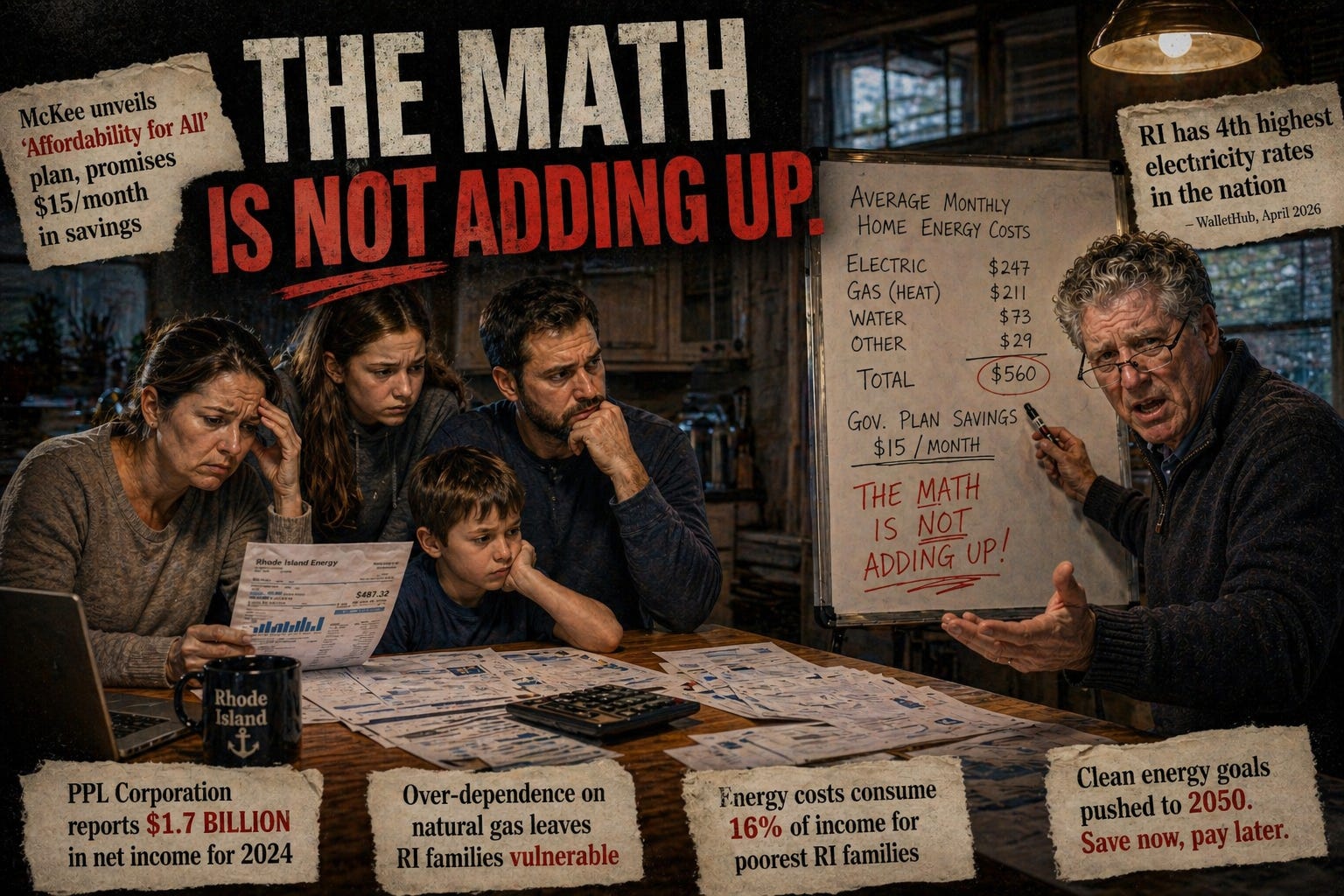
Do the math. One billion dollars over five years for roughly four hundred thousand Rhode Island households works out to about one hundred and eighty dollars a year per household.
Fifteen dollars a month.
That is the Governor’s answer to Maria’s four hundred and eighty seven dollar bill.
The Numbers the Press Conference Left Out
Rhode Island has the fourth highest residential electricity rates in the country as of April 2026. Twenty eight to thirty one cents per kilowatt hour. Forty to sixty one percent above the national average.
Official figures show a typical household paying around one hundred sixty to one hundred seventy dollars monthly for electricity alone. Real world numbers put the average closer to two hundred and forty seven dollars. Add gas heating, water, and winter peaks and total home energy costs routinely hit five hundred to six hundred and fifty dollars for families across this state.
April’s seasonal supply adjustment delivered approximately seven dollars in relief for the average customer. Not even half of the promised fifteen yet.
Meanwhile Rhode Island Energy’s parent company PPL Corporation reported one point seven billion dollars in net income in 2024.
One point seven billion dollars. While Maria is posting in a Facebook group about whether she can keep the lights on.
Rhode Island ratepayers are subsidizing a highly profitable out of state corporation. And the Governor is holding press conferences to celebrate fifteen dollars a month.
What Fifteen Dollars Actually Does
A working family with a four hundred dollar electric bill sees less than four percent relief from this plan.
Fixed income seniors, renters in older inefficient homes, and middle class households with electric heat face the same impossible choices they faced before the announcement. The press conference did not change their math.
Energy costs consume sixteen percent of income for the poorest Rhode Island families. Even moderate income households earning around forty eight thousand dollars spend thousands annually on energy while delinquency rates climb. Rhode Island’s median household income sits around eighty three thousand dollars. But with housing costs, grocery bills, and stagnant wages many families are already stretched before the electric bill arrives.
Fifteen dollars a month does not change any of that. It does not even scratch the surface.
What Is Actually In This Plan
Here is what did not make the press conference highlights.
Over five hundred and seventy million dollars of the claimed billion dollar savings comes from slowing the Renewable Energy Standard and pushing one hundred percent renewables from 2033 all the way out to 2050. The rest comes from scaling back net metering credits, capping energy efficiency programs at seventy five million dollars annually, and capitalizing road repaving costs after utility digs.
That last one does not save ratepayers money. It shifts costs to future ratepayers. Rhode Island Energy still recovers every approved cost plus its guaranteed profit through regulated rates. The accounting changes. Maria’s bill does not.
Organizations like the Acadia Center are right to call this save now pay later. Less investment in clean supply and efficiency means greater dependence on volatile natural gas, which already powers roughly eighty seven percent of Rhode Island’s electricity generation. When natural gas markets move every Rhode Island household feels it. We are not fixing the structural problem. We are handing it to the next generation with a bigger price tag attached.
An Election Year Plan Built for a Press Release
McKee’s Affordability for All tour launched while his political future remains uncertain. Rhode Islanders should ask a direct question.
If this plan is genuinely transformative why does it push every hard decision, real efficiency investment, supply diversification, the renewable transition, all the way out to 2050.
Because the hard work does not fit on a campaign mailer. The political reward lives in the announcement. The consequences live in Maria’s mailbox every single month.
What the General Assembly Needs to Do Right Now
The Governor does not get to be the last word on this. The General Assembly and the Public Utilities Commission have the tools. What Rhode Island needs is the will to use them.
Here is what real relief actually looks like.
Restore full investment in energy efficiency. Efficiency is the cheapest way to lower costs across the board. The arbitrary seventy five million dollar spending cap is not fiscal discipline. It is self-sabotage that will cost ratepayers more over time. Reduce demand and prices follow.
Diversify supply and fast track permitting. Rhode Island’s overdependence on out of state natural gas is a structural vulnerability every family pays for when markets tighten. Fast track permitting for new generation capacity including gas bridge capacity, nuclear, and hydro where it is low cost and zero emission. Invest in transmission upgrades. Stop leaving ratepayers exposed to price swings nobody in Providence seems willing to address.
Real consumer protections. Ban deceptive residential supplier contracts that have already cost Rhode Island ratepayers millions. Strengthen retail choice and community choice aggregation. These are documented ongoing harms. They need to stop.
Income based payment plans that actually work. Implement Percentage of Income Payment Plans that cap energy costs at six percent or less for vulnerable households. A fifteen dollar flat credit means something completely different to Maria than it does to a household earning six figures. Income based plans scale to actual need. They are proven in other states. The General Assembly needs to stop stalling and pass them.
Transparency and accountability with teeth. Require ten year rate impact modeling for every policy change. Hold utilities to real performance standards. Stop allowing blank check bonuses funded by ratepayers while PPL Corporation posts one point seven billion dollars in net income.
The General Assembly has bills sitting before it right now on rate transparency, nuclear and hydro inclusion in the Renewable Energy Standard, and income based payment plan implementation. Every week those bills sit idle in committee is another month families across this state pay the price.
Maria is still in that Facebook group. So are hundreds of other Rhode Islanders posting about bills they cannot afford to pay.
The General Assembly has the tools. The bills exist. The mandate is clear.
So why are those bills still sitting in committee while PPL Corporation counts its profits?