

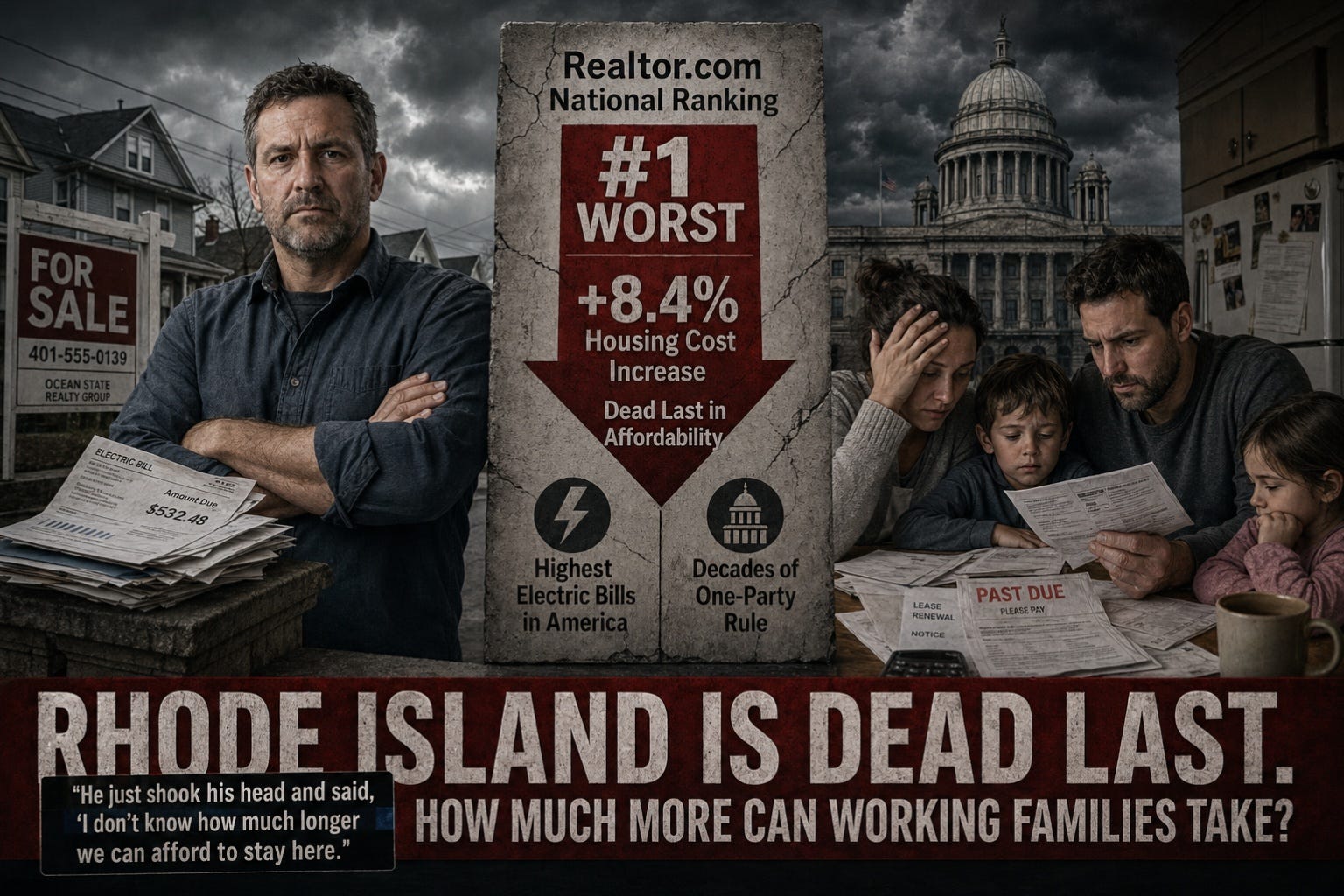
I was having lunch with a coworker a few weeks ago. Good guy. Works hard. Him and his wife both work full-time, two kids at home, doing everything right. Somewhere between the food and the coffee he just shook his head and said, “I don’t know how much longer we can afford to stay here.”
He wasn’t complaining. He wasn’t making a political statement. He was just doing the math out loud. And the math wasn’t working.
That moment stuck with me. Because he is not an outlier. He is Rhode Island right now.
Dead Last. Not Bottom Ten. Dead Last.
Realtor.com just published a ranking of every state in the country by housing affordability. Rhode Island landed at the very bottom. We recorded the highest jump in total housing costs as a share of gross income of any state in America, 8.4% in a single year. We were already one of the most expensive states before this report came out. Now we’re the fastest going in the wrong direction.
Think about what that number means in a real life. It means the young teacher who wants to buy her first home in Newport County is being priced out. It means the couple who both work full-time and still can’t get ahead on rent. It means the retired veteran on a fixed income watching his property tax bill climb every year while his pension stays flat. It means families quietly deciding to move to North Carolina or Florida or anywhere that isn’t bleeding them dry.
This didn’t happen by accident. This is the direct result of policy choices made by people who have faced no real accountability at the ballot box for a very long time.
What Unchecked Power Produces
Rhode Island’s General Assembly is one of the most one-sided legislative bodies in the United States. Democrats have held commanding supermajorities in both chambers for decades. That kind of unchecked, single-party control produces a predictable result. Spending that keeps growing. Regulations that keep stacking. Energy mandates that sound reasonable in a press release and translate into some of the highest electricity bills in the country. Zoning laws so restrictive that basic supply and demand has been suspended, guaranteeing that home prices keep climbing no matter how desperate the need becomes.
When there’s no real competition, no genuine accountability, no opposition with enough votes to force a debate, the natural tendency is drift. Policies get passed that serve insiders and donor networks more than working families. And working families pay the price, month after month, in their rent, their utility bills, their grocery bills, and eventually in the decision to leave.
This is not a story about bad people. It’s a story about what happens when any party, anywhere, holds power without consequence for too long.
Senator de la Cruz Is Saying What Needs to Be Said
Senate Minority Leader Jessica de la Cruz, who represents District 23, saw the Realtor.com data and said it plainly. Rhode Island is on the wrong list again, and Democrat policies have made it worse. She didn’t just say that. She put a bill in front of her colleagues.
Senate Bill S-2672 is a phased income tax reduction of 2% per year over five years. Modest and responsible. She’s also pushing to repeal the energy mandates driving utility bills higher for every family and small business in this state. And she’s calling for real permitting reform so that housing development can move forward in urban and suburban areas without years of red tape and delay.
She put it simply: we shouldn’t settle for affordability when we can aim for prosperity.
She’s right. And she deserves backup. Not just words of support, but actual votes, actual seats, and an actual General Assembly that’s balanced enough to force real debate and real accountability.
The Solutions Are Not Complicated
Rhode Island does not need to accept decline as a permanent condition. The tools to turn this around are well understood. What’s been missing is the political will to use them, and the political competition to force the issue.
Start with housing supply. The single most effective thing this state can do to bring housing costs down is make it possible to build more housing. That means cutting through zoning restrictions, shortening permitting timelines, and giving builders a predictable path from application to construction. More supply puts downward pressure on prices. That’s not ideology. That’s how markets work.
Fix the tax burden. Senator de la Cruz’s S-2672 is the right starting point on income taxes. But the property tax burden on homeowners and seniors in this state is also crushing, and it deserves serious attention. Targeted relief through homestead exemptions, senior freeze programs, and income-based credits would give real breathing room to families who have invested the most in their communities. And Rhode Island’s estate tax is long past its expiration date. We are one of the only states still punishing families for the effort of building something and wanting to pass it on.
End the energy mandate trap. Rhode Island already has some of the highest electricity rates in the continental United States. The current energy mandates are adding costs to every household and every small business without a realistic plan for managing the transition or protecting ratepayers. An all-of-the-above energy approach that includes renewables alongside natural gas and nuclear would lower bills, improve grid reliability, and make this state more competitive. Ideology is not a substitute for an electric bill people can actually pay.
Reduce regulatory friction on businesses and jobs. Rhode Island loses employers and jobs to neighboring states in part because our regulatory and tax climate sends the signal that businesses are not especially welcome here. Targeted incentives for manufacturing, trades, logistics, and technology companies, combined with a genuine effort to reduce the burden on small businesses, would raise household incomes. Higher incomes make housing more affordable. These things connect.
Expand educational options for families. Families are not going to choose Rhode Island, or stay in Rhode Island, if they don’t feel confident about their children’s schools. Expanding access to charter schools, vocational programs, and education savings accounts gives every family, regardless of zip code or income, a real choice. It also creates accountability in a system that has in too many places shielded itself from consequences.
Demand fiscal discipline before asking for another dollar. Rhode Islanders are not opposed to strong public services. We believe in good infrastructure, safe communities, and schools that work. But we expect efficiency and results, and for too long the General Assembly has offered spending without accountability. Before any new tax or mandate, do the basic work of proving the money we already collect is being used wisely.
The Case for a Purple Rhode Island
The political label on your voter registration does not change what you pay at the pump, at the grocery store, or when the landlord puts the new lease on the table. Working-class Democrats in Woonsocket and Central Falls feel this affordability crisis just as sharply as Republicans in Coventry or independents in Newport County.
Rhode Island is, at its core, a purple state. Voters here are pragmatic. They care about results. They have elected Republican governors. They have crossed party lines when they believed it served their families. The problem is that legislative races, especially in off-year cycles, don’t generate the same attention as statewide contests. That’s where the supermajority gets reinforced, not because people are satisfied with the results, but because not enough voices have pushed back loudly enough.
A more balanced General Assembly, one where Republicans, independents, and fiscally grounded Democrats have enough seats to force genuine debate and real compromise, would produce better policy for everyone. Not because the minority always has the right answer, but because competition and accountability improve governance. Always.
Who This Fight Belongs To
If you’re a Republican, show up. The data is on your side and the frustration is widespread. Run for office. Support candidates. Make the case.
If you’re an independent, your vote has never mattered more in a Rhode Island legislative race. Don’t sit this one out.
If you’re a working-class Democrat or a soft Democrat who is tired of paying more for everything while the people in power talk about affordability without delivering it, you are not obligated to vote for failure because it has a D next to its name. Senator de la Cruz is not asking you to change your values. She is asking you to demand that your values, a fair shot, real opportunity, a state where working people can actually get ahead, be delivered by the people you send to the State House.
What You Can Do Right Now
Call or write your state representative and senator. Tell them to support S-2672 and the full housing and energy reform agenda.
Share this with five people who feel the squeeze but don’t follow the politics closely. They are the people who will decide these races.
Show up to town halls and public hearings. The room is usually full of lobbyists and insiders. Your presence changes that dynamic.
If you have ever thought about running for local or state office, 2026 is the year. These races are won on small margins. One engaged, credible candidate can change a district.
Vote in every election as though your family’s financial future depends on it. In 2026, it does.
Rhode Island Is Worth This Fight
This is not a eulogy for the Ocean State. This is a rallying cry.
We have a great location, strong communities, a real workforce, and more assets than most states our size. We are not a state without potential. We are a state that has been held back by a political structure that has grown comfortable with failure and disconnected from the daily reality of working families.
My coworker shouldn’t have to sit at lunch and wonder whether he and his wife can afford to stay in the state they’re raising their kids in. Neither should your neighbor, your coworker, or your kids.
The Realtor.com map is a wake-up call. Senator de la Cruz’s S-2672 is a starting point. And the coalition of Republicans, independents, and disaffected Democrats who are ready for something real is the foundation.
Rhode Island can be better than this. The question is whether we’re organized enough and committed enough to make it happen.
I believe we are.