

Rhode Island needs a serious property tax relief and efficiency plan.
Too many people in this state feel like they did what they were supposed to do. They worked. They bought a home. They stayed put. They paid the mortgage for years. And then instead of finally getting a little breathing room, they look at their tax bill and realize the pressure never really stopped. For a lot of Rhode Islanders, paying off the house no longer feels like security. It feels like reaching one finish line only to find another bill waiting on the other side.
That is not how this is supposed to work.
Property taxes are one of the most direct ways families experience the cost of government. You can argue about policy from 30,000 feet, but a tax bill in the mailbox is personal. It affects whether a senior on a fixed income can stay in the home they spent decades paying for. It affects whether a working family can keep up with rising costs. It affects whether younger Rhode Islanders even believe homeownership is worth chasing here.
And the frustration is not just about the number itself. It is about the feeling that the bill keeps going up while regular people are expected to just absorb it. It is about the sense that too many decisions are made without enough visibility, without enough accountability, and without enough urgency about what all of this is doing to the people footing the bill.
Rhode Island does not need another vague promise about affordability. It needs a framework that actually deals with the pressure homeowners are under while also respecting the reality that local government still has to function.
That is the point of this proposal.
This is not a final bill draft. It is not a complete fiscal note. It is not a magic wand. It is a practical framework for how Rhode Island could reduce pressure on homeowners, improve transparency, reward efficiency, and create a more honest conversation about the long-term drivers of local tax growth.
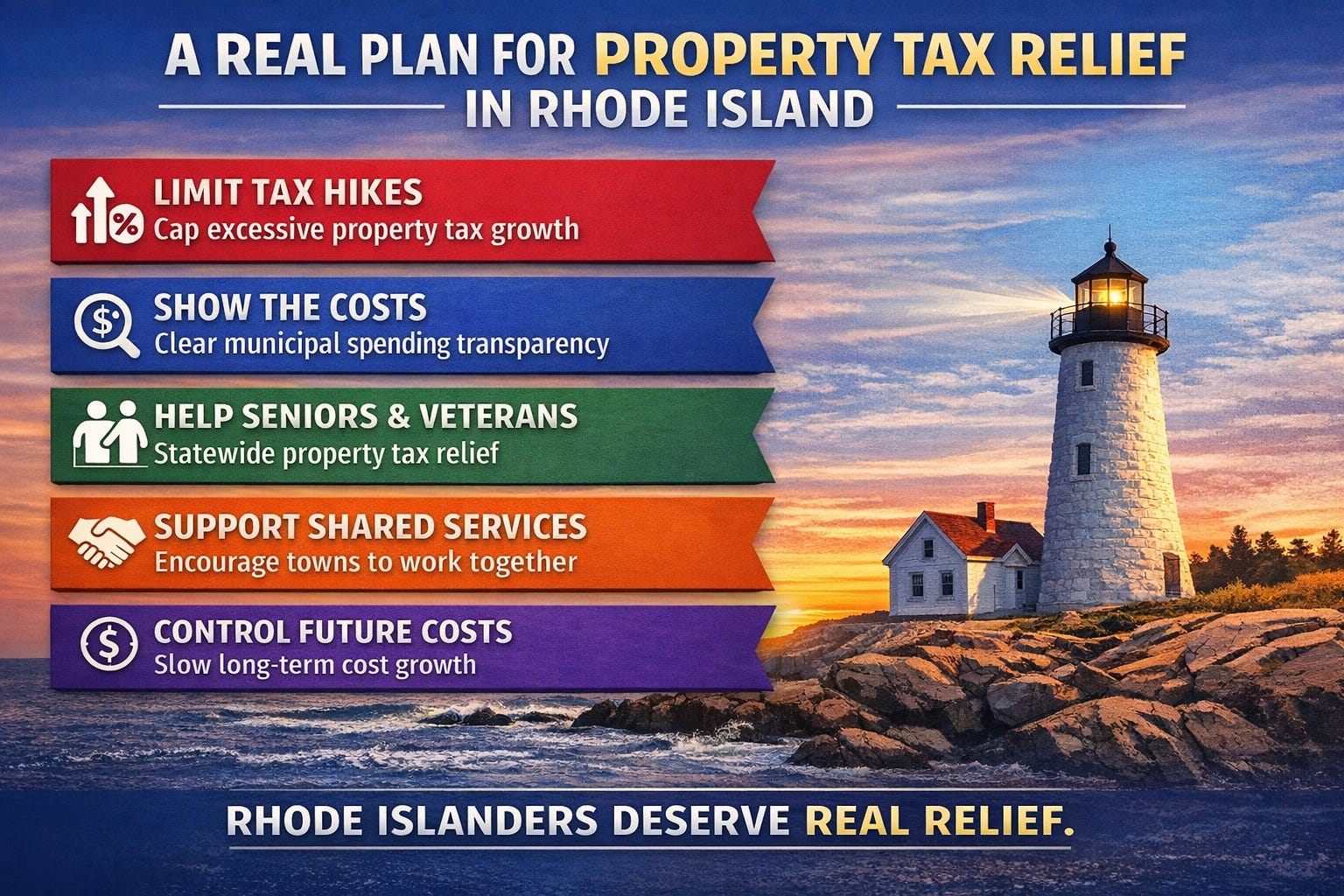
The framework is built around five core ideas:
1. Limit annual property tax growth
2. Show the costs
3. Help seniors and veterans
4. Support shared services
5. Control future costs
None of these ideas alone solves everything. Together, though, they point in the direction Rhode Island should be moving if we are serious about making this state more affordable for the people who already live here.
Why this conversation matters
Property taxes do not hit everybody the same way.
If you are wealthy, they are a line item. If you are comfortable, they are a frustration. But if you are a senior on a fixed income, a veteran trying to hold onto stability, or a working family already juggling housing, utilities, groceries, insurance, and everything else, they can become one more way the ground keeps shifting under your feet.
And Rhode Islanders know the pattern. Costs rise. Government says the increase is necessary. Residents are told there is no alternative. Then a year later the burden goes up again. People may not follow every budget hearing or every contract negotiation, but they understand the end result just fine. They feel it.
That is what makes this issue different from a lot of abstract political arguments. This is not some distant ideological debate. This is about whether people can keep up. It is about whether government is asking reasonable things of the public. It is about whether the system is built to protect the people paying into it, or simply to preserve itself.
Rhode Island is also a small state with a lot of overlapping local systems. That does not automatically mean waste, but it does mean the burden is on leadership to prove that the structure we have is delivering value. If taxpayers are going to keep being asked for more, they have every right to ask harder questions about transparency, duplication, benefit growth, and whether local government is operating as efficiently as it could.
This plan starts there.
1. Limit annual property tax growth
The first pillar is simple: local property tax growth should not keep running ahead of what families can reasonably absorb.
That does not mean towns should never be allowed to raise taxes. It does mean there should be a clearer guardrail around how fast local tax burdens can grow in the normal course of government. A practical model would tie allowable annual growth to inflation and population growth, while allowing narrow exceptions for genuine emergencies, legal mandates, or voter-approved overrides.
Why does this matter?
Because one of the biggest frustrations homeowners feel is not just the size of the bill, but the unpredictability and steady creep of it. Families try to budget. Seniors try to plan. People assume that once the mortgage is gone, the worst of the housing pressure is behind them. But if the tax burden keeps climbing year after year with no clear discipline around it, homeownership never really stabilizes.
A growth limit would not solve every budget problem. Towns would still need to make hard decisions. But that is exactly the point. A cap is not just a tax policy tool. It is a management discipline tool. It forces local governments to prioritize, justify increases more clearly, and think harder about cost growth instead of assuming the homeowner will just pick up the difference.
Critics will say towns need flexibility. They are right, to a point. Towns do need flexibility for true emergencies and unusual circumstances. That is why any serious proposal should include narrow exceptions and a transparent override process. But flexibility cannot become a permanent excuse for unlimited growth. Homeowners need some protection too.
The broader principle here is straightforward: if families are expected to live within real-world limits, government should be expected to do the same.
2. Show the costs
This may be the strongest and most defensible part of the entire framework.
Rhode Islanders should be able to see, clearly and easily, where their local tax dollars are going.
That means every city and town should publish a searchable public dashboard showing major spending categories, salary schedules, union contracts, healthcare costs, pension formulas, departmental spending, and other significant obligations in plain language. Not hidden across scattered PDFs. Not buried in meeting packets. Not technically public but practically inaccessible. Actually visible.
This matters for a simple reason: transparency is the foundation of accountability.
A lot of residents feel like they are being asked to trust a system they cannot fully see. They know the tax bill. They know the budget keeps growing. But many do not have a clear, usable way to understand what is driving the increase. That gap creates cynicism, confusion, and a sense that public decisions are happening one layer beyond real public scrutiny.
A dashboard does not automatically lower taxes. But it changes the environment in which spending decisions get made. It becomes harder to hide weak explanations. It becomes easier for residents, journalists, watchdogs, and even local officials themselves to compare costs and ask better questions. And when decisions are defensible, leaders should welcome the chance to defend them in the open.
This is not about vilifying public workers. It is not about trying to create resentment toward teachers, police officers, firefighters, or town employees. It is about basic transparency for taxpayers. If local government is going to ask more from homeowners, then homeowners deserve more visibility into how the money is being spent.
That should not be controversial. It should already be standard.
3. Help seniors and veterans
One of the clearest failures in the current system is that relief is too uneven and too patchwork.
In some towns, seniors and veterans may have access to certain exemptions or forms of relief. In others, the rules differ. The paperwork differs. The generosity differs. The awareness differs. That leaves too many people in the dark or dependent on where they happen to live rather than what they actually need.
Rhode Island should build a simpler statewide property tax relief structure for income-qualified seniors and honorably discharged veterans.
That relief could include exemptions, credits, and carefully structured deferral options. But the key idea is that help should be based more on income and need, and less on a confusing patchwork that changes from one municipality to the next.
Why is this so important?
Because these are the Rhode Islanders most vulnerable to being taxed out of stability. A senior who spent decades paying off a home should not have to spend retirement wondering whether rising property taxes are going to outpace a fixed income. A veteran who served the country should not have to fight through a maze of inconsistent local rules just to find out whether any relief is available. And families trying to care for aging parents should not be forced into impossible choices because the system is too fragmented to respond with basic fairness.
There is also an important difference between real relief and relief that only delays the problem. Deferral can help in some cases, but deferral alone is not enough if it simply turns today’s tax pressure into tomorrow’s lien. That may be useful as one option, but it should not be the whole answer. A serious plan should combine immediate help with long-term protection, so people are not just surviving the bill in the short run while passing a different burden down the line.
This pillar is about something bigger than tax policy. It is about stability, dignity, and a basic promise that the people who built their lives here should not be pushed out by a system that refuses to adapt.
4. Support shared services
Rhode Island is a small state. That should be an advantage. Too often, it is treated like a coincidence.
For a state this size, we still operate through a lot of overlapping local systems, duplicated functions, and separate administrative structures. That does not mean every town should lose its identity or that every service should be consolidated. But it does mean we should be asking much harder questions about where cooperation could lower costs without harming service quality.
That is where shared services come in.
The state should actively encourage towns to work together on functions like dispatch, purchasing, IT, fleet maintenance, public works coordination, and other back-office or operational areas where duplication may be adding cost without adding value. In some places, broader regional approaches may also make sense, but the smarter place to start is with the functions that are easiest to share and easiest to measure.
This matters because efficiency does not always come from cuts. Sometimes it comes from redesign.
A lot of Rhode Islanders hear “efficiency” and immediately assume somebody is talking about layoffs, service loss, or stripping communities of local control. That is not what this is about. This is about reducing avoidable overhead, getting more buying power where possible, and making sure taxpayers are not paying for the same administrative wheel to be reinvented thirty-nine different ways just because that is how things have always been done.
If shared services are structured well, the upside is not only financial. They can also improve consistency, purchasing leverage, technical capacity, and resiliency. Smaller towns in particular can benefit when they are not forced to carry every burden alone.
This is one of those areas where Rhode Island’s size should help it. The question is whether we are willing to use that advantage.
5. Control future costs
The final pillar is the one that makes some people uncomfortable, but it has to be part of the conversation.
If Rhode Island wants long-term property tax relief, it cannot ignore long-term cost growth.
That includes pension obligations, benefit structures, and other future commitments that shape local budgets year after year. Talking about that does not mean attacking public employees. It does not mean taking away earned benefits from current retirees. And it does not mean pretending workers are the problem. It means recognizing that if future obligations grow faster than taxpayers can sustain, the pressure eventually lands somewhere. In many communities, that “somewhere” is the property tax bill.
A serious approach would bring together local leaders, labor representatives, taxpayers, and policy experts to look at long-term sustainability honestly. The goal would not be punishment. It would be to make sure future commitments are affordable, defensible, and aligned with what the broader public can actually carry over time.
This is where too many politicians go weak. They either run from the issue completely or they talk about it in a way that sounds like a cheap shot at workers. Both approaches fail.
The real task is harder and more responsible than that. It is to protect what has already been earned, respect the people doing the work, and still be honest that the future has to be built on a structure taxpayers can support. Anything less is just kicking the can and pretending the bill will somehow disappear on its own.
It will not.
What this plan is trying to do
Taken together, these five pillars are meant to reduce the long-term pressure that keeps pushing property taxes higher.
They target several of the biggest underlying problems at once: unchecked cost growth, weak public visibility into spending, fragmented local operations, uneven relief for vulnerable homeowners, and a broader lack of structural discipline around future obligations.
That does not mean every town would feel the exact same effect in the exact same way. Rhode Island is small, but communities are still different. Tax bases differ. Budget pressures differ. Existing local relief differs. Some towns already do certain things better than others.
But the statewide direction is what matters here.
The point is to create a structure where homeowners have more protection, taxpayers have more visibility, vulnerable residents have more support, and local government has stronger incentives to operate efficiently instead of simply passing cost growth through.
That is how real relief becomes possible over time.
What this plan is not
It is important to be clear about what this framework is not.
It is not a plan to gut essential services.
It is not a plan to punish rank-and-file public workers.
It is not a call to strip communities of local identity or pretend every town can be run exactly the same way.
It is not a final filed bill, and it is not being sold as a finished fiscal note.
This is a framework. Its purpose is to put serious, practical ideas on the table and move the conversation past the usual cycle of frustration, excuses, and avoidance.
That distinction matters.
Too often in Rhode Island, people can sense the problem clearly, but the discussion never gets very far because the moment anyone raises structural reform, the conversation gets derailed into caricatures. Either you are accused of wanting to cut everything, or you are told the burden simply has to keep rising because there is no alternative.
There are alternatives. They just require more honesty than the status quo is comfortable with.
Why this matters politically and personally
This issue matters on the merits, but it also matters because it gets at something deeper in Rhode Island politics.
A lot of people feel like they are being asked to carry more and more while getting less confidence that government is making disciplined, transparent, accountable decisions with their money. That feeling crosses party lines. It crosses age groups. It crosses town lines.
People may disagree on the exact policy mix, but the frustration is real.
They want to know someone is actually paying attention to the pressure they are under. They want to know somebody is willing to question the way things have been done. They want to know that “affordability” is not just another word politicians throw around before going back to business as usual.
That is part of why this framework matters to me.
I am not putting this out there as somebody who thinks he has every answer. I am putting it out there because too many Rhode Islanders are asking a fair question: how do you spend years paying off a home and still feel like you are falling behind?
That question deserves more than a shrug.
The bottom line
Rhode Islanders should not feel like paying off their home still leaves them trapped under a rising tax burden with no real relief and no real say.
We can have a more honest conversation than that. We can build a system that is more transparent, more efficient, and more protective of the people paying the bills. We can take seniors and veterans more seriously. We can reduce duplication where it makes sense. And we can stop pretending that long-term cost growth is somebody else’s problem.
This state does not become more affordable by accident. It becomes more affordable when leaders are willing to confront the real drivers of cost and put practical reforms on the table.
That is what this framework is meant to do.