


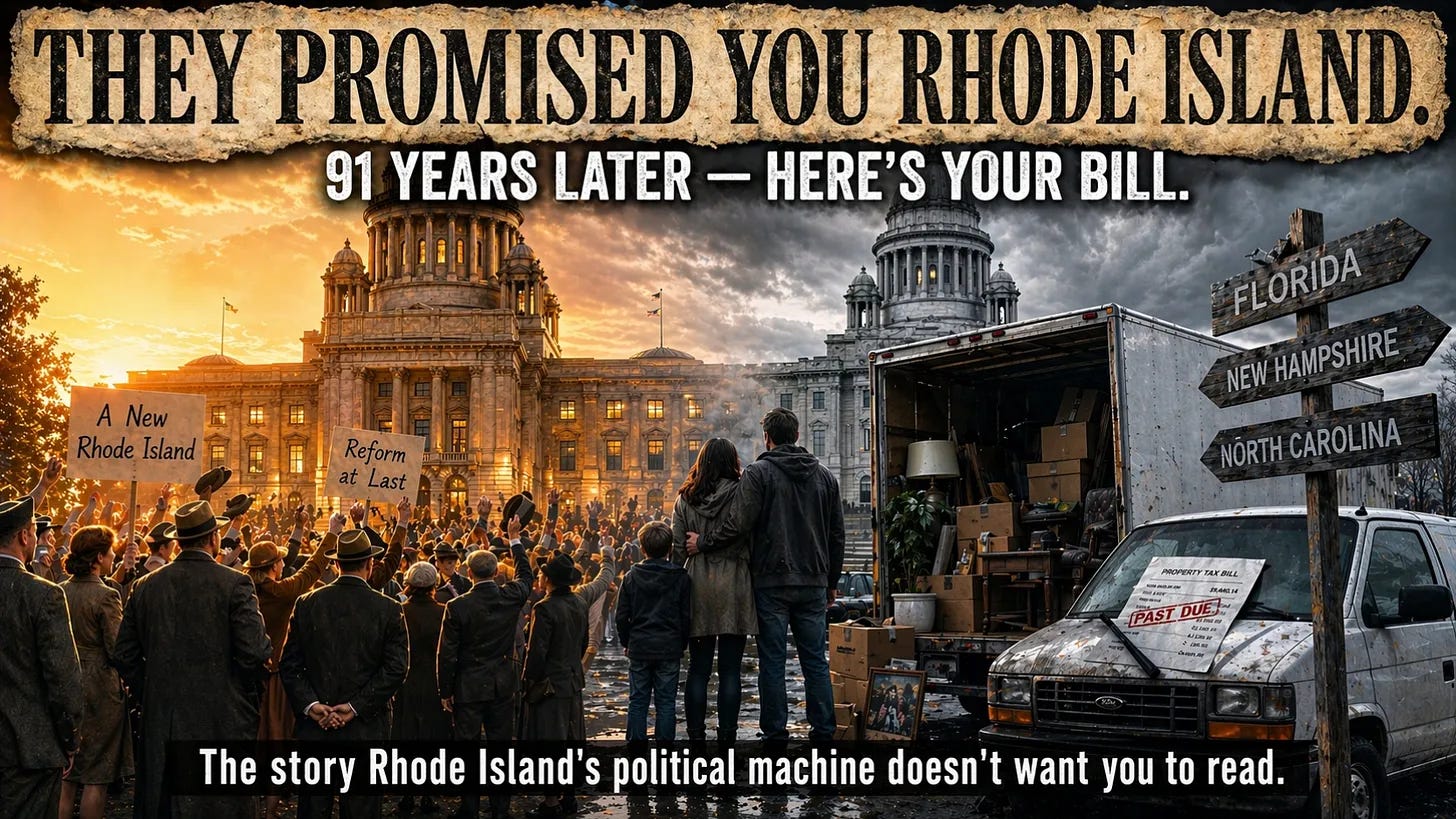
My neighbor knocked on my door on a Tuesday afternoon last spring and told me he was moving to North Carolina.
He and his wife had talked about it for two years. They ran the numbers a dozen times hoping they were wrong. They weren’t. The property tax bill had gone up four times in eight years. The rent on their daughter’s apartment near Providence was eating half her paycheck. The job he’d been promised kept getting delayed. And one morning he woke up and said enough.
He didn’t leave because he wanted to. He left because Rhode Island made it impossible for him to stay.
He was the third family on my street in two years.
I’m telling you that because what follows is not a collection of abstractions. These are real people. Real families. Real decisions that should have never had to be made. And if you live in this state right now you already know someone who made the same one.
So let’s talk about what actually happened here. And how long it has been happening.
What They Promised
You already know how it started.
On New Year’s Day 1935 Democrats seized Rhode Island’s statehouse in fourteen minutes flat. No election. No mandate. State police at the chamber doors. A party that rewrote the rules of power while most Rhode Islanders were still recovering from the night before.
We told that story last week. Thousands of you shared it. Because it hit something real.
But the coup was only the beginning.
What came after it is the part that actually matters to you today. When Democrats seized power they made a promise. Reform. Accountability. A government that finally worked for working people. The mill workers. The factory hands. The immigrant families in Providence who had been locked out of power for decades.
Future House Speaker Matthew Smith later told the honest truth about what actually followed. Democrats, he wrote, “failed to capitalize on its revolution and institute the program of reform it had promoted for so long.” Instead they “indulged in a wild scramble for patronage and power.”
The real victims, Smith concluded, were the people of Rhode Island.
He wrote that in 1973.
I read it last week and honestly had to put my phone down for a minute. Because it reads like it was written this morning.
The Recession Nobody Wanted to Say Out Loud
In the fall of 2025 URI economist Leonard Lardaro said what the numbers had been screaming for months.
Rhode Island was officially in a recession.
Not a rough patch. Not a period of adjustment. A recession. For the entire calendar year of 2025 not one key economic indicator improved over the year before. Zero months of progress. Twelve months of straight decline.
Maybe I’m wrong to be angry about that. But I don’t think I am.
Because while families across this state were tightening their budgets and making impossible decisions about where they could afford to live — the same machine that seized power on New Year’s Day 1935 was still running the building on Smith Hill. Without interruption. Without accountability. Without a single genuine fear of losing.
That combination — recession plus zero accountability — is not a coincidence.
It is a consequence.
The People Who Left
Last year 1,600 more Rhode Islanders moved out of this state than moved in.
Read that again.
Over two decades Rhode Island has lost more than 107,000 residents to other states. They took nearly a billion dollars in annual income with them. Every single year more people choose to leave than stay.
These are not statistics. They are the couple who bought their first house on your street and lasted four years before the tax bill broke them. The young nurse who trained at Rhode Island Hospital and moved to New Hampshire because she could actually afford a one-bedroom apartment there. The small business owner who relocated to a state where the regulatory climate felt like it was designed to help him instead of slow him down.
I have watched it happen in real time. And every time someone leaves I think the same thing.
This didn’t have to be this way.
The Number That Says Everything
Rhode Island’s unemployment rate sits at 4.8 percent right now. Higher than the national average. Higher than the New England regional average. For seven straight quarters.
Seven. Straight. Quarters.
We are not just underperforming compared to the rest of America. We are underperforming compared to our own neighbors. Massachusetts. Connecticut. New Hampshire. Maine. Vermont. Every state around us is doing better. All of them have something Rhode Island has been missing for nearly a century.
Real competition. Real consequences for failure.
New Hampshire has traded legislative control between parties multiple times in the last twenty years. The result is consistently one of the most affordable states in New England with a growing population and employers who want to be there. Massachusetts has elected Republican governors repeatedly because voters understood that divided government produces better outcomes than one party running everything without challenge.
Rhode Island voters can make that same rational decision.
They just need someone to give them the honest picture to do it.
Your Invoice
So here is what 91 years of unchecked one-party control has actually cost the average Rhode Island family.
Some of the highest property taxes in all of New England. A housing crisis decades in the making while the same legislators held the same hearings and passed the same incremental measures that never moved the needle. A pension system that collapsed in 2011 and had to be gutted — breaking promises made to teachers, firefighters, and state workers who had planned their entire retirements around a guarantee the state couldn’t keep. A business climate that ranks near the bottom nationally. Young families making painful decisions to leave places they loved because the math simply stopped working.
And now — a population projected to shrink by more than 5 percent by 2050.
Fewer Rhode Islanders. Fewer families. Fewer kids in classrooms. A state quietly hollowing out while the machine that seized power on New Year’s Day 1935 keeps running.
That is your invoice. Not a political argument. An invoice. Ninety-one years of one-party rule. Paid in full by the people who stayed and the people who couldn’t.
This Is Not About Picking a Side
I want to be straight with you.
I’m a Republican. I’m planning to run for District 74 in 2028. I have a perspective here and I’m not going to pretend I don’t.
But I mean this genuinely — this is not about making Rhode Island a red state. I would say the same thing if the parties were reversed. Unchecked power in either direction produces the same result every time. Comfortable insiders. Broken promises. Ordinary families paying the price.
What Rhode Island needs is not a pendulum swing. It needs two parties that both know they can lose. That pressure — real, credible, electoral accountability at every level — is the missing ingredient. It has been missing since January 1, 1935.
November 2026
My neighbor texts me from North Carolina sometimes.
He likes it there. The weather is better. His mortgage payment is lower than his old property tax bill was. He doesn’t regret leaving. He just regrets that leaving felt like the only option.
That is what 91 years actually costs. Not just in dollars. In people. In neighbors. In the version of Rhode Island we were supposed to get and never did.
I started writing these stories because I got tired of watching good people leave a place they loved. That is the whole reason. Not a talking point. Just the truth.
November 2026 is the moment Rhode Island voters can start demanding better. Not by picking a side. By refusing to hand out free passes in every district, for every seat, at every level.
The coup took 14 minutes.
Taking the state back starts in November.